
When I first stepped into the little house I call home, the coat of fresh paint and newly fluffed throw pillows made it feel like a sanctuary. But what I quickly realized was that appearances don’t tell the whole story. That first winter, I noticed our indoor air felt stale, maybe a little dusty. One of our kids developed a runny nose that just wouldn’t quit, even after changing bedding and vacuuming constantly. I started to wonder: could the “health” of our home go deeper than what we could see on the surface?
As a certified home inspector and building biology practitioner, I began walking through each corner of our house with fresh eyes. I checked the seals around windows, peeked into crawl spaces, tested humidity levels, and thought through how every pipe, vent, and appliance could affect not just the building but our bodies. Bit by bit, I realized that what seemed like ordinary maintenance chores were really foundational health practices.
That’s why I want to share this with you. Not because I love cleaning for cleaning’s sake, but because I believe deeply that a well-maintained home is more than cozy and comfortable. It’s protective. It’s healing. It’s the physical shell where your family sleeps, breathes, grows, and rests. And when we maintain that shell thoughtfully and consistently, we create a living space that nourishes life rather than challenges it.
Why Routine Home Maintenance Actually Matters
Most homeowners think maintenance is about preventing water damage, preserving resale value, or avoiding costly repairs. And that’s all true. But the bigger story is what’s happening at the microscopic and chemical level inside your home. The systems we often overlook are the ones that directly impact the air we breathe and, ultimately, how our bodies feel day to day.

Moisture and Humidity: More Than Just a Mold Problem
Indoor humidity is one of the most overlooked factors when it comes to air quality, but it’s also one of the most powerful. Moisture affects everything: building materials, microbial growth, toxin release, and even the way chemicals move through your home.
Many common building materials and furnishings slowly release volatile organic compounds, or VOCs, into the air over time. Things like paints, varnishes, floor finishes, pressed-wood furniture or cabinetry, and carpets all do this. These emissions often begin when materials are new, but environmental conditions, especially temperature and humidity, strongly influence the rate at which they off-gas. Research published by the National Center for Biotechnology Information and studies available through ScienceDirect have documented this relationship extensively.
What’s particularly striking is how much humidity can amplify this process. Scientific studies show that elevated relative humidity can significantly increase the rate at which VOCs off-gas from common materials. For example, under conditions of increased humidity, some water-based floor varnishes and wall paints showed measured increases in total VOC emissions, according to research published in PMC and MDPI journals. In one real-world indoor air study published on PubMed, increasing relative humidity from approximately 21% to between 58% and 75% caused measured concentrations of certain VOCs to double or triple.
The problem doesn’t stop with manufactured materials. Another study found that materials like drywall and carpet dust, when exposed to high moisture over time, not only foster microbial growth like mold and bacteria but also release what are called microbial VOCs, or mVOCs. These are gases produced by mold and bacteria themselves, and they add further to the chemical load in your indoor air. This research, published in PMC, helps explain why moisture-damaged areas often have that distinctive musty smell, and why the health effects extend beyond what we typically think of as “mold exposure.”
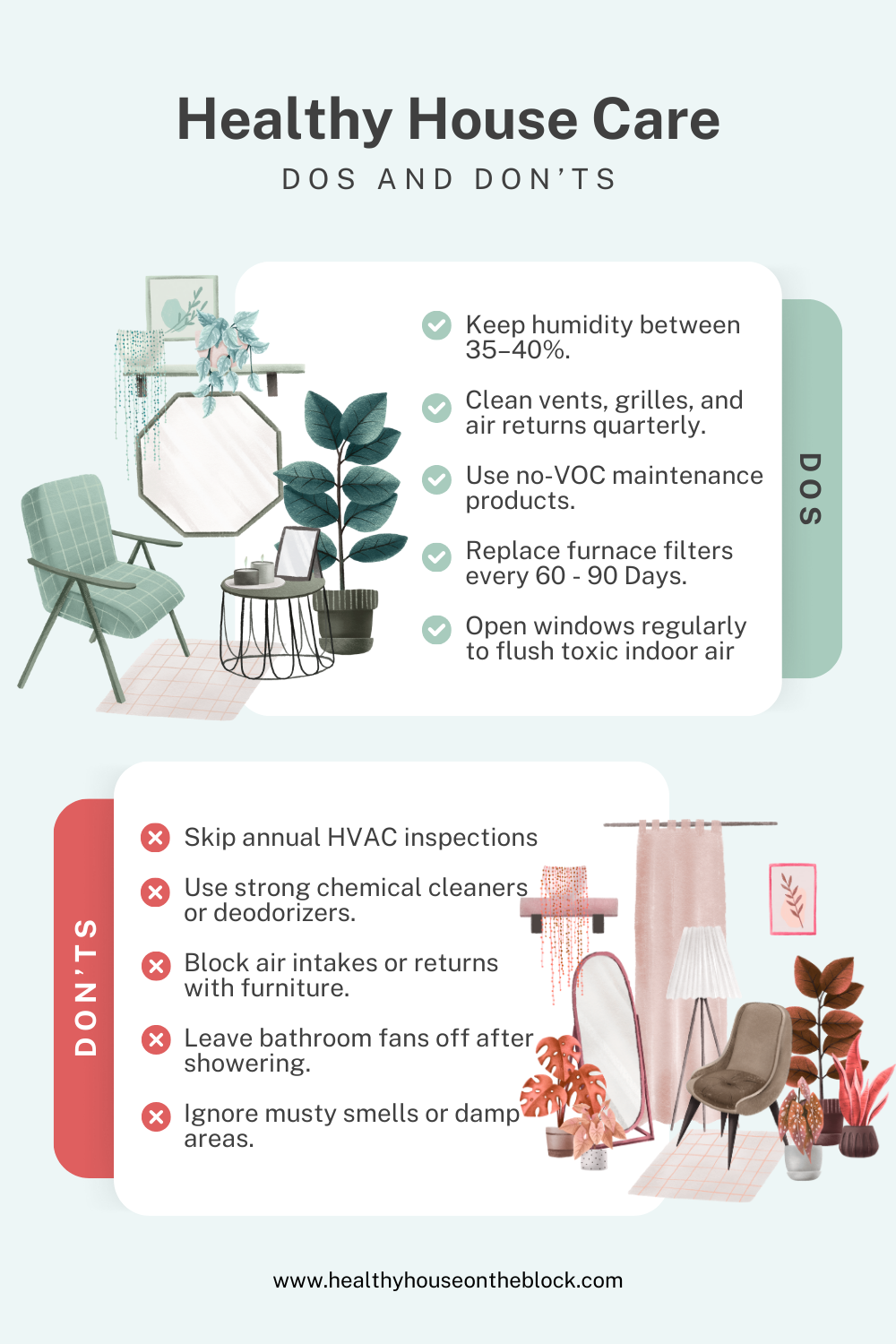
Because of this, maintaining proper humidity and addressing moisture issues aren’t just about preventing visible mold growth. They also help limit chemical exposures that can contribute to headaches, respiratory irritation, fatigue, cognitive fog, and long-term indoor air quality problems, as documented by IAQ Works and other indoor air quality research sources.
What this means is that you need to think about humidity as a year-round concern. Keep indoor relative humidity ideally between 30% and 40%. This is the commonly recommended healthy zone from building science research, low enough to discourage mold and microbial growth but not so dry as to create static, skin irritation, or overly dry air that can irritate respiratory passages.
Use a reliable hygrometer or humidity monitor to check humidity periodically, and place monitors in multiple locations. Basements, kitchens, bathrooms, laundry areas, and bedrooms can all have different humidity levels, and problem areas often develop in the places we check least often. Digital hygrometers are inexpensive and can give you real-time data about what’s actually happening in your home rather than relying on how the air “feels.”
Fix leaks, condensation, or damp spots promptly. Even small, slow leaks can create localized high-humidity conditions that trigger both microbial growth and increased VOC emissions. Ensure proper drainage around your foundation by checking that downspouts redirect water at least five to six feet away from the house. Check that attic or crawl space ventilation is working properly if relevant to your home’s design. In many homes, these spaces act as buffers that affect the whole-house moisture balance.
Use exhaust fans when cooking or showering, and run them for 15 to 20 minutes after you’re done to fully remove the moisture generated by these activities. Ventilate when weather permits, opening windows on opposite sides of the house to create cross-ventilation when outdoor conditions are favorable. Consider running a dehumidifier in damp areas like crawl spaces and basements if humidity tends to rise, particularly during humid summer months or in climates with high seasonal humidity. Many modern dehumidifiers have built-in humidistats that allow them to maintain a target humidity level automatically.
Humidity is foundational. Get this right, and every other aspect of your home’s health improves because you’re controlling one of the primary drivers of both biological and chemical indoor air quality problems.

Ventilation and Air Exchange: Diluting What Builds Up
Modern building methods often make homes more airtight, which is excellent for energy efficiency but can backfire when ventilation is insufficient. If the air inside stays stagnant, pollutants build up: dust, VOCs from paints or cleaning products, combustion byproducts from gas appliances, carbon dioxide from human respiration, and more. The EPA and the Environmental Research Institute have both documented how inadequate ventilation in tight buildings leads to elevated indoor pollutant concentrations.
Ventilation, whether through opening windows, using mechanically vented fans in kitchens and bathrooms, or installing a whole-house ventilation system, dilutes indoor pollutants and helps maintain healthy indoor air. The principle is straightforward but critical: fresh outdoor air (assuming good outdoor air quality) replaces stale indoor air, reducing the concentration of whatever has accumulated inside. ENERGY STAR and the Environmental Research Institute both emphasize that proper ventilation is one of the primary strategies for maintaining healthy indoor air in modern, efficient homes.
Without effective ventilation, moisture from cooking, showering, and laundry, combined with dust and chemical off-gassing, can linger and accumulate. This is documented in research from the EPA and the Environmental Policy Institute, which show that inadequate ventilation creates a compounding effect where multiple pollutant sources interact and concentrations rise steadily over time.
Homes built after the mid-1990s are increasingly airtight, which means that without consistent fresh air exchange, VOCs accumulate, carbon dioxide builds up (which can affect sleep quality and cognitive function even at moderately elevated levels), humidity increases, microbial growth accelerates, odors linger, and air becomes stagnant and pollutant-dense. The tighter your home, the more intentional you need to be about bringing in fresh air.

So what can you do? Use exhaust fans in bathrooms and kitchens, and this is critical, make sure they actually vent outside, not just into an attic or crawl space. I’ve inspected many homes where bathroom fans simply blow moist air into the attic, creating perfect conditions for mold growth in a space that’s difficult to monitor and remediate. Check where your exhaust fans vent, and if they terminate in an attic or crawl space, have them properly ducted to the exterior.
When weather permits and outdoor air quality is good, open windows and doors to let fresh air circulate. Even in winter, brief periods of open windows, called “shock ventilation,” can rapidly exchange indoor air without significantly affecting your heating costs. In moderate seasons, take full advantage of natural ventilation by opening windows on opposite sides of your home to create airflow.
For tight, well-insulated homes, consider installing a whole-house ventilation system such as a heat recovery ventilator (HRV) or energy recovery ventilator (ERV), especially in climates where winters are long and windows stay closed for extended periods. According to the Environmental Research Institute, these systems provide continuous, controlled ventilation while recovering heat (and in the case of ERVs, moisture) from exhaust air, making them energy-efficient solutions for maintaining air quality without significant heating or cooling penalties. An HRV or ERV essentially allows your home to “breathe” in a controlled, efficient way.
Clean exhaust fan covers twice a year to ensure they’re operating at full capacity. Dust and debris buildup can significantly reduce airflow. Keep bedroom doors cracked at night to reduce carbon dioxide buildup, particularly in smaller bedrooms or rooms with poor air circulation. Carbon dioxide itself isn’t toxic at the levels typically found in homes, but elevated CO₂ often indicates inadequate ventilation and can be associated with stuffiness, poor sleep quality, and morning grogginess.

HVAC and Air Filtration: What Circulates Matters
Your heating, ventilation, and air conditioning system constantly moves air through ductwork, and over time, dust, debris, and even mold spores can accumulate in filters, ducts, or vents. If neglected, these contaminants recirculate throughout the home, according to research from NADCA (the National Air Duct Cleaners Association) and Bradenton Building Sciences.
Regular filter changes, typically every one to three months depending on your usage patterns, filter type, and whether you have pets, are a low-cost, high-impact way to remove dust, pet dander, pollen, and other airborne particles. The EPA and Bradenton Building Sciences both emphasize that this simple maintenance task is one of the most effective interventions for improving indoor air quality.
For stronger protection, especially for families with allergies, asthma, pets, or sensitive immune systems, consider upgrading to high-efficiency filters such as MERV-rated filters (typically MERV 11 to 13 for residential applications), or even adding HEPA-level filtration or activated carbon filters for VOCs and odors. Research from the Environmental Research Institute and Bradenton Building Sciences shows that higher-efficiency filtration can significantly reduce particulate matter in indoor air. However, and this is important, you need to make sure your HVAC system can handle higher-efficiency filters. Systems designed for basic fiberglass filters may not have sufficient fan power to pull air through denser, higher-MERV filters, which can reduce airflow, strain the blower motor, and decrease system efficiency.

Establish a regular schedule and stick to it. Check your HVAC filter monthly, especially during high-use seasons like summer and winter when your system runs frequently. Replace or clean when needed, which might be sooner than the manufacturer’s recommended interval if you have pets, live in a dusty area, or are doing renovation work. Inspect vents or ductwork for visible dust buildup. If you notice reduced airflow from your vents, increased dust accumulation in your home, persistent musty odors, or visible mold growth around vents, consider professional duct cleaning or installing higher-grade filters or supplemental air purification.
Choose filters that work for your specific system, because not all systems can handle high-MERV filters without modification. Check your system’s specifications or consult with an HVAC professional to determine the highest-efficiency filter your system can accommodate without airflow restrictions. Clean air returns and supply vents regularly with a vacuum attachment to prevent dust buildup at these critical air entry and exit points. Have ducts professionally inspected every few years, especially in older homes where dust, debris, and potentially biological growth may have accumulated over decades.
Your HVAC system plays a major role in circulating and filtering the air you breathe daily. Cleaner air means healthier lungs, a calmer immune system that isn’t constantly responding to particulate matter and allergens, and better sleep quality.

Combustion Safety: The Invisible Threat
Fuel-burning appliances like gas stoves, furnaces, water heaters, and fireplaces can release carbon monoxide (CO), nitrogen dioxide (NO₂), and other combustion byproducts that are harmful or even deadly if not properly vented. According to ENERGY STAR and the U.S. Consumer Product Safety Commission, incomplete combustion or inadequate venting of combustion appliances is a significant and preventable source of indoor air pollution. Since some gases like carbon monoxide are odorless and colorless, you won’t know you’re exposed without proper detectors, as emphasized by ENERGY STAR.
Carbon monoxide is particularly insidious because it interferes with your blood’s ability to carry oxygen. Even at levels below those that cause acute symptoms, chronic low-level exposure can affect cognitive function, cardiovascular health, and sleep quality. Natural gas combustion, even when complete, produces water vapor (which contributes to indoor humidity) and carbon dioxide, while incomplete combustion produces carbon monoxide and other harmful byproducts.

Make sure all combustion appliances are installed and vented correctly according to manufacturer specifications and local building codes. Test carbon monoxide detectors regularly, every six months is a good baseline, and replace detector units according to manufacturer recommendations (typically every five to seven years, as sensors degrade over time). Place CO detectors on every level of your home and near sleeping areas. Ensure exhaust flues, chimneys, or vent pipes are clear and intact. These can become blocked by bird nests, leaves, snow, or ice, or can deteriorate over time, particularly older masonry chimneys.
If you smell a strange odor, notice soot buildup around appliances, experience frequent pilot light outages, or suspect incomplete combustion based on yellow or orange flames (which should typically be blue for natural gas), call a qualified HVAC technician immediately. These are signs of combustion problems that need professional attention.
Inspect gas lines and connections for leaks, damage, or corrosion. Maintain furnaces, gas water heaters, and gas fireplaces according to manufacturer schedules, typically annually. Ensure proper flue draft, which is the flow of combustion gases up and out of your home. Poor draft can cause combustion byproducts to spill back into living spaces. Make sure exhaust vents aren’t blocked by snow accumulation in winter, leaves in fall, or any other debris.
Even a perfectly maintained home can become unsafe if combustion appliances aren’t venting properly. Carbon monoxide exposure, even at low levels that don’t trigger detectors calibrated for acute exposure, can affect cognitive function, increase cardiovascular load, and degrade sleep quality. This is why professional annual maintenance of combustion appliances isn’t optional, it’s a critical health and safety measure.

Source Control: Stopping Problems Before They Start
Indoor air pollution often originates from inside the home itself: VOCs from paints, finishes, and cleaning supplies; off-gassing from new furniture, mattresses, or textiles; residual pesticide or chemical residues; dust, pet dander, and pollen. According to the Environmental Research Institute and the EPA, the most effective way to improve indoor air quality is to reduce or eliminate pollution sources before they become problems, a strategy called source control.
This makes intuitive sense. It’s far more effective to prevent a pollutant from entering your indoor air than to try to filter it out afterward. Source control should be your first line of defense, followed by ventilation to dilute whatever remains, and finally filtration to capture what ventilation doesn’t remove.

Whenever possible, choose low-VOC or zero-VOC paints, finishes, sealants, and furnishings. However, be aware that “low-VOC” is a marketing term that isn’t always well-regulated, and as we discussed earlier, even low-VOC products still off-gas, particularly under conditions of elevated humidity or temperature. Look for products with third-party certifications like Green Guard Gold, which have stricter emissions standards.
Store chemical cleaning products in well-ventilated areas, ideally outside living spaces like in a garage or outdoor shed. Volatile chemicals continue to emit even when capped, and concentrated storage in a kitchen cabinet or bathroom closet can become a localized source of elevated VOC concentrations. Limit indoor use of harsh chemical cleaners, or switch to gentle, non-toxic alternatives. Many effective cleaning solutions can be made from simple ingredients like vinegar, baking soda, and hydrogen peroxide, which don’t contribute VOCs to indoor air.
Keep clutter to a minimum, because dust and off-gassing tend to collect and concentrate in cluttered spaces. More surfaces mean more area for dust to settle, and stacked items reduce air circulation, creating microenvironments where pollutants accumulate. Choose fragrance-free, low-toxicity cleaners. Many commercial fragrances are complex mixtures of volatile compounds that contribute to indoor VOC loads, and fragrance chemicals aren’t required to be fully disclosed on product labels. Use safer finishes on furniture and floors, opting for hardwood or tile over vinyl when possible, and water-based or natural oil finishes over solvent-based products. Avoid aerosol chemicals, which create fine mists that remain airborne longer and are more easily inhaled.
Store chemicals in the garage or outdoor storage, not indoors where their emissions enter living spaces. Ventilate thoroughly when using craft materials, adhesives, or paints, keeping windows open and using fans to create airflow that directs fumes outside. Consider doing major painting or finishing projects when you can leave windows open for extended periods.
Little steps here accumulate into significant improvements in your indoor air quality, and source control often costs less and requires less energy than the filtration and ventilation needed to address pollution after it’s released.
Common Myths About Indoor Air Quality
Myth: If I bought low-VOC paint or materials, I don’t need to worry about VOCs anymore.
Reality: Even low-VOC or water-based materials can off-gas, and off-gassing often continues, especially under high humidity or higher temperatures. Environmental conditions like humidity strongly influence VOC emission rates, as documented in studies published through ScienceDirect and PMC. The term “low-VOC” refers to initial emissions or chemical content, not to the complete absence of emissions over time.
Myth: My home is new or recently renovated, so once the paint and carpets are in, the risk is over.
Reality: Off-gassing can persist for months or even years, and if indoor humidity is high or temperature fluctuations are frequent, emissions may continue well beyond initial installation. Research published by NCBI and PMC shows that material emissions are ongoing processes, not one-time events.
Myth: If I can’t smell anything, the air must be clean.
Reality: Lack of odors doesn’t mean the air is clean. Many VOCs and other pollutants are odorless or present at concentrations below human odor detection thresholds but still at levels that affect health over time. Proper ventilation and humidity control is crucial regardless of whether you can smell problems.
Myth: Newer homes don’t have air quality problems.
Reality: Newer homes are often more airtight, which is excellent for energy savings but means pollutants get trapped without proper ventilation. Modern building materials may also off-gas more than traditional materials, and the combination of tight construction plus higher-emitting materials can create worse indoor air quality than in older, leakier homes if ventilation isn’t addressed intentionally.
Myth: Dusting and regular cleaning are enough to keep my home healthy.
Reality: Surface cleaning helps with settled particulates, but dust and debris are only part of the problem. Pollutants from building materials, VOC off-gassing, and moisture-driven chemical emissions happen continuously and can’t be cleaned away. They require environmental control through proper humidity management, ventilation, and source control.
Myth: Once materials air out, the risk is gone.
Reality: Off-gassing can continue for months or years, depending on material type, environmental conditions, and the specific compounds involved. Some VOCs are released rapidly at first and then taper off, while others are released steadily over long periods.
Why This All Matters
People spend a vast majority of their time indoors. Studies cited by the Asthma and Allergy Foundation of America suggest we spend more than 90% of our time inside buildings. Indoor air can be significantly more polluted than outdoor air, especially when a home is poorly ventilated, has elevated humidity, or uses materials that off-gas, according to the Asthma and Allergy Foundation and EPA research. Poor indoor environments, including mold, dust, VOCs, and combustion pollutants, have been linked to allergies, asthma, respiratory problems, and broader health impacts, as documented by ENERGY STAR and the U.S. Consumer Product Safety Commission.
Regular home maintenance isn’t just about preserving property value or preventing expensive repairs. It’s about safeguarding health, reducing long-term risks, and creating a home that truly supports your wellbeing on a daily basis.
Your home isn’t just a backdrop for your life. It’s a living system that interacts with your body every time you breathe, sleep, cook, or relax. When you treat home maintenance as part of health maintenance, you move from a reactive mindset of “fix it when something goes wrong” to a proactive, wellbeing mindset of “nurture this space so it nurtures me and my family.”
In particular, controlling humidity and moisture, and understanding its influence on chemical emissions, can significantly reduce hidden indoor air quality risks that many homeowners don’t even know exist. That’s especially important for families, sensitive occupants like children, elderly family members, and those with asthma or allergies, and anyone seeking a truly healthy home environment.
HOME MAINTENANCE WORKSHEETS
While it’s easy for me to tell you how important it is to take care of specific areas of your home that are working systems, it can be daunting to know HOW and WHEN to take care of these things. This is exactly why I’ve created my seasonal checklists. This breaks down your home tasks by season and helps you get an idea of the items you should be checking on a semi-regular basis.
You can download yours in my free Online Resource Library where you’ll get access to the Seasonal Maintenance Checklists and many other free resources.

As someone who cares deeply about healthy living, this approach aligns with the kind of life you want to build for yourself and your family. A home maintained with intention becomes a sanctuary not only of comfort and beauty but of safety, vitality, and peace. It becomes a place that actively supports your health rather than one that quietly undermines it through accumulated moisture, stagnant air, or unrecognized chemical exposures.
The science is clear about the relationships between indoor environmental conditions and health outcomes. The good news is that most of the interventions that matter are straightforward, manageable, and cumulative in their benefits. Small, consistent actions add up to significant improvements in the environment where you spend most of your time.
And that makes all the difference.
References
Humidity and VOC Emissions:
- National Center for Biotechnology Information (NCBI). Studies on humidity effects on VOC emissions from building materials.
- ScienceDirect. Research on temperature and humidity influence on VOC off-gassing rates.
- PubMed. Indoor air quality study documenting VOC concentration increases with elevated relative humidity.
- PMC (PubMed Central). Studies on moisture-damaged materials and microbial VOC emissions.
- MDPI. Research on water-based floor varnish and wall paint VOC emissions under varying humidity conditions.
Indoor Air Quality and Ventilation:
- U.S. Environmental Protection Agency (EPA). Indoor air quality guidance and pollutant information.
- ENERGY STAR. Ventilation and combustion appliance safety guidelines.
- Environmental Research Institute. Research on ventilation systems and indoor air quality in tight buildings.
- Environmental Policy Institute (EPI). Studies on pollutant accumulation in poorly ventilated spaces.
- IAQ.Works. Indoor air quality resources and humidity control recommendations.
HVAC and Filtration:
- National Air Duct Cleaners Association (NADCA). Standards for duct cleaning and maintenance.
- Bradenton Building Sciences. Research on HVAC filtration and indoor air quality.
Combustion Safety:
- U.S. Consumer Product Safety Commission. Carbon monoxide safety and combustion appliance guidelines.
General Health Impacts:
- Asthma and Allergy Foundation of America. Studies on time spent indoors and indoor air quality health impacts.