We often focus on the small, daily wins—swapping a plastic container for glass or choosing a better dish soap. These are the building blocks of a healthy life, and they truly matter. But eventually, you might find yourself standing in the middle of a room, looking at old carpet or a dated kitchen, and realizing you are ready for a bigger shift.
When you reach the stage of planning a renovation or a major replacement, you aren’t just updating your aesthetic. You are participating in a powerful form of preventative healthcare. These big healthy home ideas allow you to address the “bones” of your environment, creating a foundation that supports your family’s health for decades to come.

The Science of Why We Make These Changes
It is easy to feel like indoor air quality is an invisible concern, but the research shows it is one of the most significant factors in our long-term wellness. According to the EPA, levels of several organics are 2 to 5 times higher indoors than outdoors. When we bring in new materials, we often introduce a “chemical soup” of volatile organic compounds (VOCs).
Research published in Environmental Health Perspectives has linked the presence of phthalates and flame retardants in household dust to endocrine disruption and respiratory issues in children. By choosing inert, natural materials during a big project, you aren’t just decorating; you are actively reducing the chemical body burden on your nervous system and your children’s developing bodies. This is the heart of building biology: creating an indoor environment that mimics the safety of the natural world.

The Healthy Project Formula: Your Deep-Dive Framework
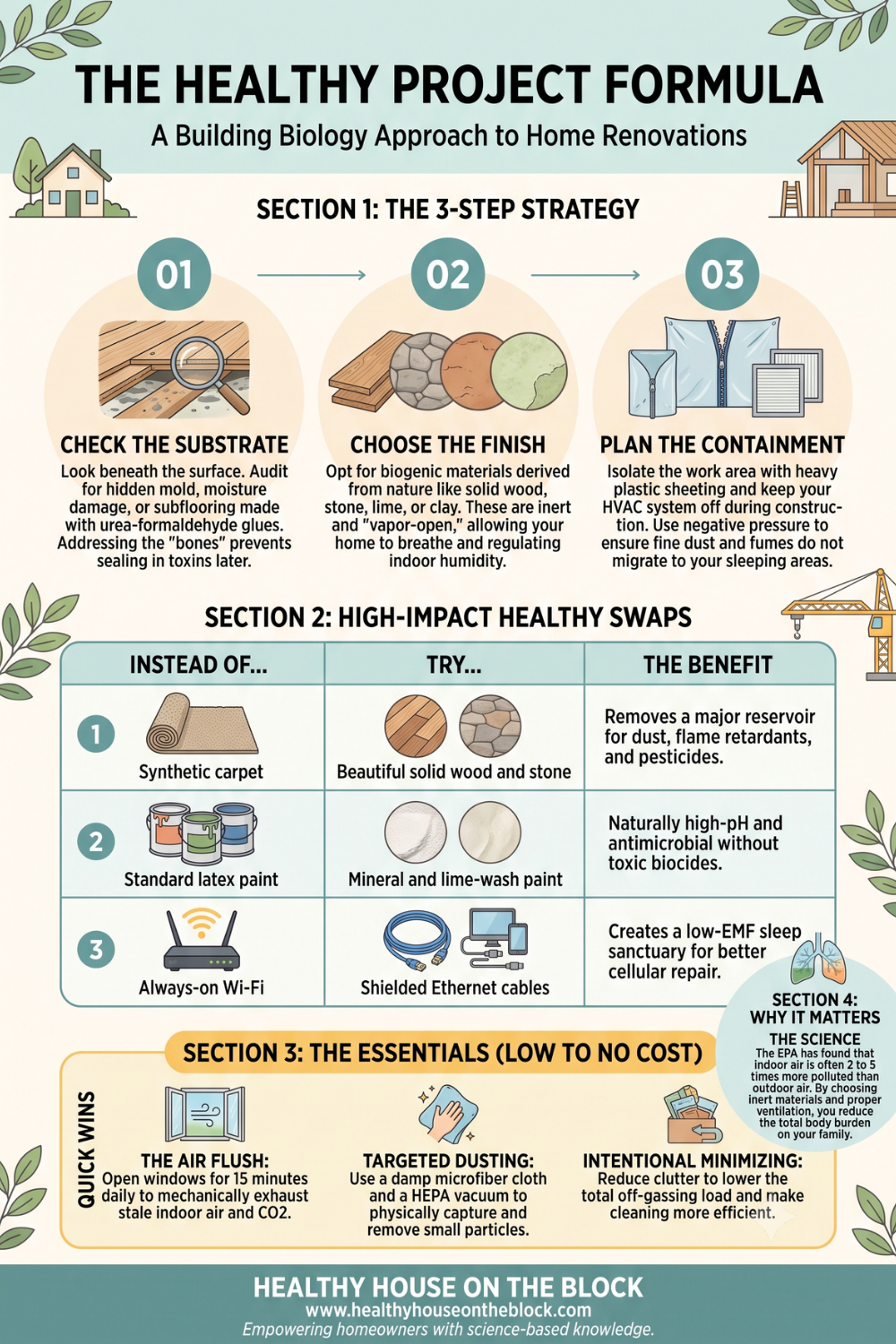
1. Check the Substrate: The Hidden Foundation
Before you worry about the pretty finish, look at what is underneath. The substrate is the material that supports your final choice—think of the subflooring under your hardwood or the drywall behind your tile.
- Audit for Old Issues: If you are redoing a bathroom, check the wall cavities for any signs of past water intrusion. Sealing in old mold or moisture is a recipe for poor air quality later.
- Identify Off-Gassing Culprits: Many subfloors are made of plywood or OSB (oriented strand board) held together with urea-formaldehyde glues. If you are replacing a floor, consider if the substrate itself needs a sealer or a swap to a formaldehyde-free alternative. Addressing the hidden layers prevents “sealing in” problems that could off-gas into your home for years.

2. Choose the Finish: Selecting Biogenic Materials
This is where you select the materials that will be in constant contact with your air and your skin. In building biology, we aim for “biogenic” materials—things derived from nature.
- Nature-Identical Choices: Look for solid wood, stone, lime, clay, and cork. These materials are generally carbon-neutral and do not require the complex chemical stabilizers or anti-microbial treatments found in synthetic alternatives.
- The “Vapor-Open” Concept: Whenever possible, choose finishes that allow your home to “breathe.” Synthetic finishes often create a plastic-like vapor barrier that can trap moisture. Natural oils, waxes, and mineral-based finishes allow moisture to move through, which is a key factor in long-term mold prevention.
3. Plan the Containment: Protecting Your Sanctuary
Renovations are messy, and the dust created is often highly concentrated with toxins from old materials. I always advise my clients to create a rigorous “containment” plan before the first hammer swings.
- Zoning Your Home: Use heavy-duty plastic sheeting and zip-poles to create a physical barrier between the construction zone and the rest of your house.
- Manage the Air: Keep your HVAC system completely off during the dustiest phases of work. If you leave it on, you risk pulling construction dust into your ductwork and spreading it to every bedroom. Use a HEPA air scrubber in the work area to capture particles at the source and keep a window open in that room to create negative pressure.
High-Impact Healthy Home Ideas for Your Next Project
1. Prioritizing the “Fifth Wall” (Flooring)
Flooring is perhaps the most significant of all healthy home ideas because of its sheer surface area. If you currently have wall-to-wall synthetic carpet, it is likely acting as a “sink” for allergens, pesticides tracked in from outside, and flame retardants. This blog post about flooring and this one about carpet are going to get you started in the right direction.
- The Science: A study by the Silent Spring Institute found that older carpets can hold a legacy of toxic chemicals that are no longer even in use.
- The Solution: Replacing carpet with solid wood or tile is a massive step forward. If you choose wood, look for FSC-certified solid timber and finish it with a plant-based oil or a water-based, zero-VOC sealer. This ensures that the largest surface in your home is helping you breathe easier.
2. Creating a Low-EMF Sanctuary
In our modern world, we are constantly bathed in radio frequency (RF) radiation from Wi-Fi, Bluetooth, and cellular signals. While we can’t control the world outside, we can make our homes a place of rest. A major project is the perfect time to hardwire your home with shielded ethernet cables.
By running these cables to your home office, living room, and bedrooms, you can enjoy high-speed internet with the Wi-Fi turned completely off. This is a core building biology principle—especially in my blog post all about EMFs, where we focus on creating a sleep sanctuary that allows your cells to repair without the stress of constant EMF exposure.
3. Breathable Walls with Mineral Finishes
Standard latex paint is essentially a thin layer of plastic spread over your walls. It often contains biocides to prevent mold in the can, which can off-gas long after the “new paint” smell is gone.
Instead, look into mineral-based paints or lime washes. These finishes are naturally high-pH, which means they are inherently antimicrobial and mold-resistant without the need for added toxic chemicals. They also allow for better humidity regulation within the room. You can see some of my favorite toxin-free paint options here.

Starting with the Essentials: Low-Cost, High-Impact
I know that “big” projects can come with a big price tag. If you are looking for healthy home ideas that don’t require a contractor, remember that the most important things in your home are often free.
Mastering Ventilation Ventilation is the most underrated tool in your kit. Modern homes are often built so “tightly” that they trap moisture and gases inside. Simply opening windows on opposite sides of the house for 15 minutes a day creates a cross-breeze that can drastically reduce indoor CO2 and VOC levels. It is a simple habit that acts as a “reset button” for your indoor air.
Diligent Dust Management Because many toxins—like flame retardants and heavy metals—bind to house dust, how you clean matters. Using a HEPA-rated vacuum ensures that you are actually capturing small particles rather than blowing them back out into the air. Following up with a damp microfiber cloth on hard surfaces ensures those particles are removed from the home entirely. Be sure to visit my guide for removing toxic house dust.
The Power of Minimizing Every item in your home has a chemical profile. By minimizing decor and keeping only what you truly love and use, you reduce the surface area for dust to collect. It also reduces the total “off-gassing load” of the room. A simpler, more intentional space is naturally easier to keep healthy.

Long-Term Benefits for the Family
When we implement these healthy home ideas, the benefits compound over time. We aren’t just looking for a “quick fix” for a current symptom; we are looking at the next twenty years.
By reducing the VOCs in your air and the EMFs in your bedrooms, you are supporting your family’s circadian rhythms and mitochondrial health. Children, in particular, benefit from these changes because their smaller bodies and faster respiration rates make them more vulnerable to environmental toxins. A home that is free of endocrine disruptors and respiratory irritants allows their systems to focus on growth and development rather than detoxification.
Every choice you make, whether it is a gallon of mineral paint or the decision to open a window, is a move toward a healthier, more vibrant life. If you want to dive deeper into how to vet materials for your next project, my Toxin Free Home Projects workbook is a great place to start. I am here to support you in making your home a true place of healing.
References and Further Reading
- Environmental Protection Agency (EPA). Report on the Environment: Indoor Air Quality. EPA.gov. (Research showing indoor air pollutants are often 2 to 5 times higher than outdoor levels).
- Rudel, R. A., et al. (2003). “Phthalates, Alkylphenols, Pesticides, Polybrominated Diphenyl Ethers, and Other Endocrine-Disrupting Compounds in Indoor Air and Dust.” Environmental Science & Technology. Read the study.
- Silent Spring Institute. Household Exposure Study. SilentSpring.org. (A comprehensive look at how legacy toxins like PFAS and flame retardants accumulate in household dust and older carpets).
- International Institute for Building-Biology & Ecology (IBE). The 25 Principles of Building Biology. BuildingBiology.com. (The foundational framework for choosing health-supporting materials and mitigating EMFs).
- American Lung Association. Clean Air Indoors. Lung.org. (Guidance on the respiratory impacts of indoor air pollutants and dust management).
- Indoor Air Journal. Bedroom Ventilation and Sleep Quality. (Research correlating improved fresh air exchange with better sleep efficiency and recovery).
- Healthy House on the Block. Toxin Free Home Projects Workbook. Download the Guide.