You walk down the stairs to grab a holiday decoration or switch over a load of laundry, and there it is. That distinct, heavy basement odor hits you. You immediately look around, scanning the walls, the baseboards, and the ceiling, but you don’t see a single speck of mold anywhere.
As a health-focused homeowner, I know how incredibly frustrating this can be. You want to provide the healthiest possible space for your family, but it’s hard to fix a problem you can’t actually see. Many of the moms I work with feel confused when their basement smells musty but no mold is visible. If this sounds like your home, let’s uncover the building science behind what’s really going on down there.
The Science Behind the Smell
When your basement smells musty but has no mold that you can see with the naked eye, your nose is actually picking up on something called microbial volatile organic compounds (mVOCs). According to the Environmental Protection Agency (EPA), these compounds are off-gassed by fungi as they grow in damp indoor environments, producing that characteristic moldy or musty odor long before a visible problem appears.
The smell is essentially an early warning system. It tells us that the conditions are ripe for an issue, even if it’s hiding behind the scenes.
How Your Basement Breathes
As a building biology practitioner and former home inspector, I look closely at how homes breathe. When it comes to a musty basement, the root cause usually comes down to three invisible factors: concrete porosity, relative humidity, and the stack effect.
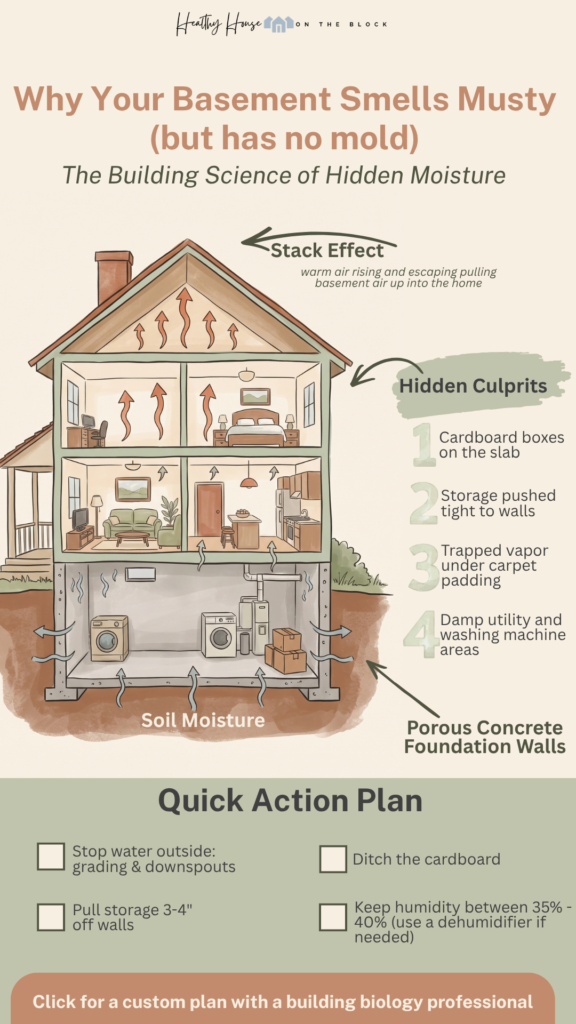
First, let’s talk about your foundation. Concrete looks incredibly solid, but it’s actually highly porous, functioning much like a dense sponge. It constantly absorbs moisture from the soil outside and transfers it inside. If your basement’s relative humidity creeps above the ideal 35 to 40 percent range, that moisture hangs in the stagnant air, creating the perfect environment for mVOCs to develop.
This matters for your whole house because of something called the stack effect. Think of your home like a chimney. As warm air rises and escapes through the upper levels of your house, it creates a vacuum that pulls replacement air up from the basement. This means the air you and your children breathe in the living room and bedrooms is heavily influenced by the hidden moisture in your lower level.
The Hidden Culprits
So where is the moisture coming from if the walls look perfectly clean. The answer usually hides in low-airflow areas. When I do home assessments, here are the most common hidden culprits I find:
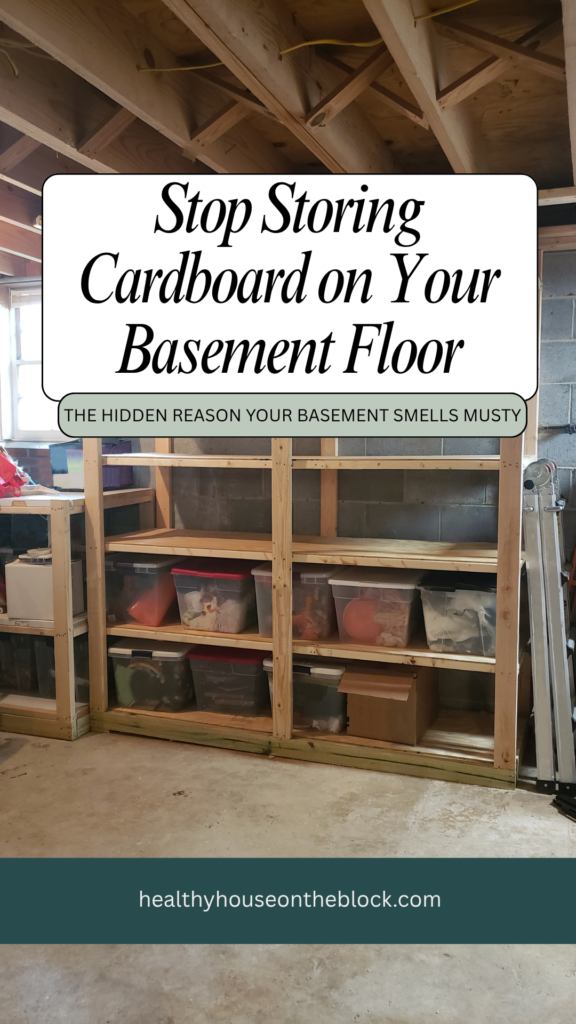
- Stored items against the walls: Plastic bins, shelving units, and seasonal decor pushed right up against exterior concrete walls trap moisture and completely block airflow.
- Cardboard on the floor: Cardboard boxes sitting directly on a concrete slab act like wicks, pulling moisture right out of the floor and holding it in the paper fibers.
- Carpet and padding: Wall-to-wall carpet in a basement acts like a giant blanket over a porous surface. The concrete releases water vapor, which then becomes trapped in the carpet pad, creating a musty odor that you can’t scrub away.
- Hidden nooks: The areas behind your washing machine, dried-out floor drains, or inside closed-off utility and storage rooms are notorious for stagnant air. Without movement, humidity builds up quickly.
Your First Action Steps
Before you worry about tearing down drywall, there are five simple, science-based steps you can take today to start improving your indoor air quality.
- Stop water at the source Before we look inside, we have to look outside. The most effective way to lower basement humidity is to stop bulk water from soaking into the soil around your foundation in the first place. Take a walk around the perimeter of your house and check your downspouts. They should extend at least five to six feet away from your foundation walls. Next, look at the soil grading. The dirt and landscaping beds around your house should always slope down and away from the concrete, never toward it.
- Create breathing room Pull all storage bins, furniture, and shelving at least three to four inches away from your exterior walls. Giving the concrete room to breathe allows the moisture to evaporate rather than getting trapped behind your belongings.
- Ditch the cardboard Swap out any cardboard boxes sitting on the floor for safer alternatives like glass or non-toxic storage containers, and elevate all stored items on open shelving.
- Measure the invisible moisture I highly recommend picking up an inexpensive digital hygrometer to monitor the humidity levels in those stagnant corners. You can also use a pinless moisture meter to safely test the concrete walls and floors yourself without doing any damage. Finding where the moisture is highest is the first step to solving the puzzle.
- Check beneath the surface If you have wall-to-wall carpet, go to a discreet corner and carefully pull back the carpet and the pad. If the concrete underneath is dark, damp, or smells strongly, you’ve found a major source of your humidity problem.
- Bring in a dehumidifier To consistently keep your basement’s relative humidity in that healthy 35 to 40 percent range, a high-quality dehumidifier is essential. Look for a model with a continuous drain hose that you can run directly to a floor drain so you aren’t constantly emptying a bucket. Taking control of the ambient moisture is one of the very best ways to stop that musty smell in its tracks.
(For a deeper dive into creating a low-toxin environment and auditing your space, be sure to read my complete guide on Fixing a Damp House).
Let's Solve the Mystery Together
If you’ve checked these areas and still feel overwhelmed, you don’t have to figure it out alone. Managing humidity and airflow can be tricky depending on your specific layout and HVAC setup.
If you’re ready for some expert guidance, I’d love to help you on a Results Review call. We’ll sit down virtually, look at your specific basement setup, and figure out how to lower your humidity levels. Together, we’ll create a short-term plan to reduce the hidden moisture causing that smell, improve your air flow, and map out clear, manageable next steps to protect your family’s health.
You can book your Healthy Home Plan consultation right here. Let’s get your home breathing easier.