Scroll through social media or search “healthy home tips,” and you’ll run into advice that feels completely out of reach. Influencers — and even some professionals — will tell you that protecting your family means tearing out drywall, replacing every piece of furniture, or dropping thousands of dollars on a full home renovation.
I want to say this plainly: if someone is telling you that you have to gut your living space to be healthy, that’s a red flag. Not because the underlying concern about our environment is wrong — it isn’t — but because advice like that ignores real life. It drains your finances, spikes your stress, and makes people feel stuck before they’ve even taken a single step.
That’s not how I approach this work, and it’s not how I want you to approach it either.

Why I Care About This
I didn’t come to this work through a textbook. I came to it because our water was contaminated by a huge corporation growing up, causing me to look deeper at what I had assumed was safe. And when I started to look for information on contaminated water, I was overwhelmed by the scary stories I found.
What I learned the hard way is that fear-based advice doesn’t actually change behavior — it just makes people freeze. So somewhere along the way, I decided that if I was going to help families build healthier homes, it would be through steps people could actually take, not a checklist that made them feel like they were failing on day one.

The Perfection Trap and Decision Fatigue
It’s easy to fall into an all-or-nothing mindset the moment you start researching environmental health. You read about off-gassing, flame retardants, or water contaminants, and suddenly every object in your house feels suspect. That’s decision fatigue setting in — and it’s a completely normal response to information overload, not a personal failing. You freeze because replacing an entire living room or re-plumbing your water system feels financially and logistically impossible.
Here’s the truth I come back to again and again: no home is completely sterile or toxin-free, and it was never supposed to be. Every home has quirks, older materials, and practical compromises baked into it. Health isn’t about achieving laboratory perfection inside your four walls. It’s about lowering the total biological burden on your body — enough that your body’s own detox systems (your liver, kidneys, lymphatic system, skin) can keep up and do their job well.

That reframe matters. Once you stop chasing zero and start working toward less, the whole process gets a lot less overwhelming.
If I were sitting across the table from someone who felt stuck, here’s exactly the order I’d walk them through — starting with what costs nothing, and saving the big investments for later, when they’re actually needed.
Phase 1: Free Daily Habits to Build Momentum
These cost nothing and require zero construction. The point of starting here isn’t that these are the most impactful changes you can make — it’s that they remove all friction, so you can build momentum and prove to yourself that this is doable.
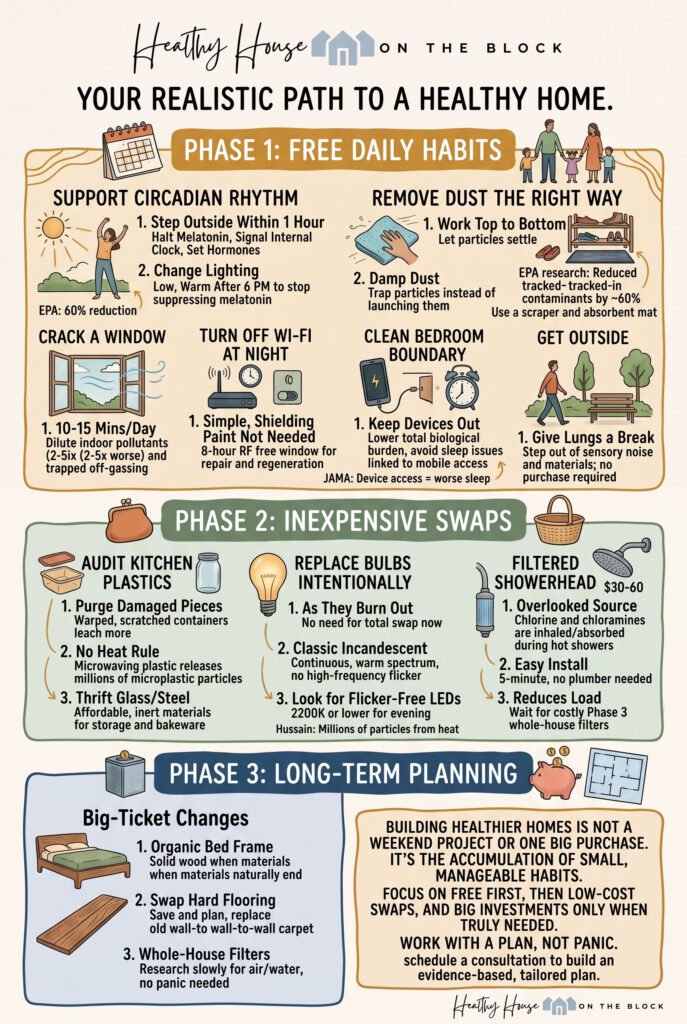
Support your circadian rhythm with light, not new fixtures. You don’t need to replace a single light fixture to fix your light environment — you just need to change how and when you use the ones you already have. Step outside within an hour of waking and let natural sunlight hit your eyes and face. That morning light exposure halts melatonin production, signals your internal master clock, and sets your hormone production up for the day ahead. Then, after 6:00 PM, turn off the bright overheads and switch to low, warm accent lighting. This isn’t a minor aesthetic preference — research published in The Journal of Clinical Endocrinology & Metabolism found that ordinary evening room light meaningfully suppresses melatonin onset and shortens how long it lasts (Gooley et al., 2011). In other words, your lamp choice at 8 PM is talking directly to your sleep hormones. (Read my full guide on Circadian Rhythm)
Remove dust the right way, not just any way. Dust isn’t just dirt — it’s a reservoir. A major nationwide meta-analysis identified dozens of chemicals routinely present in household dust, including endocrine-disrupting phthalates and flame retardants (Mitro et al., 2016). The catch is that feather dusters and dry rags don’t remove that dust — they launch it back into the air where you breathe it in. Instead:
- Work top to bottom. Start with ceiling fans, door frames, and the tops of cabinets, and let particles settle before you move to lower surfaces.
- Damp dust, don’t dry dust. A damp microfiber cloth (plain water or a drop of gentle soap) physically traps particles instead of scattering them.
- Finish with a sealed HEPA vacuum on floors, rugs, and baseboards, so fine particulates don’t just get exhausted right back into the room.

Take your shoes off at the door. This one is almost embarrassingly simple, and it’s backed by one of the more striking numbers in this whole space: EPA research found that using a doormat and removing shoes before entering a home reduced household lead dust and other tracked-in chemicals by about 60 percent. Roughly a third to nearly half of the contaminants in a typical home — pesticide residue, lead-contaminated soil, allergens — arrive on the bottoms of shoes. A simple two-mat entry system (a scraper mat outside, an absorbent mat just inside) plus a basket of house slippers by the door does most of the work here, no renovation required. (Check out my full guide on a healthy entryway)
Crack a window for a few minutes each day. It sounds almost too simple to matter, but the EPA has found indoor air can run two to five times more polluted than the air right outside your door — because most of us spend around 90 percent of our time indoors, pollutants that off-gas from furniture, cleaning products, and building materials just build up with nowhere to go. You don’t need a whole-house ventilation system to start addressing this. Opening a window for 10–15 minutes, even in cooler months, gives that trapped air somewhere to go and lets fresh air dilute what’s accumulated.
Turn off your Wi-Fi router at night. If electromagnetic fields feel like a complicated rabbit hole, skip the shielding paint and specialty fabric — just walk over to your router before bed and flip the switch. Your sleeping hours are when your body is doing its heaviest lifting: cellular repair, tissue regeneration, nervous system regulation. Giving your biology an eight-hour window free from continuous radiofrequency signals removes one more stressor from that process, without touching your daytime internet access at all.
Create a clean bedroom boundary. Keep phones, tablets, and laptops out of the room entirely. A meta-analysis in JAMA Pediatrics found that simply having a mobile device accessible at bedtime — whether or not it’s actively used — is strongly linked to shorter sleep, worse sleep quality, and more daytime sleepiness (Carter et al., 2016). Charge your phone in another room and use a basic battery-powered alarm clock instead.
Get outside when the house feels like too much. When your living space starts to feel overwhelming, physically leave it for a while. A walk through a park, a nearby trail, or even around the block gives your lungs a break and gets you out of the constant sensory noise of indoor materials and surfaces — no product purchase required.
Phase 2: Inexpensive and Thrifted Swaps
Once the free habits feel automatic, you can start making small, targeted physical changes — the kind that cost real but modest money, and that you can spread out over weeks instead of doing all at once.
Audit your kitchen plastics — don’t purge them all at once.
- Start with the damaged pieces. Warped, scratched, stained, or cloudy containers degrade faster and shed compounds more easily than intact ones — those go first.
- Repurpose what’s left for cold, dry storage. Plastic containers still have a job: dry pantry goods like beans, rice, or nuts, or non-food storage.
- Make a firm rule: no plastic near heat. Never microwave in plastic or cover food with plastic wrap while heating. Research has shown microwaving plastic containers can release millions of microplastic and billions of nanoplastic particles per square centimeter into food in as little as three minutes (Hussain et al., 2023). A plain ceramic plate or an unbleached paper towel does the same splatter-catching job without that trade-off.
- Thrift for glass and stainless steel. Secondhand stores are reliably stocked with glass bakeware, canning jars, and stainless bowls — inert materials that won’t leach into your leftovers, often at a fraction of retail price.
Replace bulbs intentionally as they burn out. You don’t need to swap every bulb in the house today — just be deliberate the next time one dies. A classic incandescent bulb produces a continuous, warm spectrum with essentially no high-frequency flicker. If you prefer LEDs, look for flicker-free, warm-spectrum bulbs (around 2200K or lower) for evening rooms.
Consider a filtered showerhead. This is one of the more overlooked swaps, and it’s inexpensive — usually somewhere in the $60–$90 range and a five-minute install with no plumber required. A meaningful share of daily chlorine and chloramine exposure comes from hot showers, not just drinking water, since heat converts chlorine into a gas that gets inhaled and also absorbed through warm, open pores. A basic carbon or KDF shower filter reduces that load without requiring a whole-house filtration system — that’s a Phase 3 project, and it’s fine to wait on it. (Here’s my top pick for a high quality shower filter)

Phase 3: Planning for the Long-Term
Big-ticket changes — an organic solid wood bed frame, swapping wall-to-wall carpet for hard flooring, whole-house air or water filtration — belong on a long-term list, not a to-do list for this week. These are things you research slowly, save for, and install when the existing materials naturally reach the end of their life. Treating them as urgent only creates panic, and panic doesn’t actually make anyone healthier.
When you’re ready to plan ahead, check out my Healthy Home University page that has all my guides and videos in one spot to help you.
Building a healthier home isn’t a weekend project or a single big purchase — it’s a slow accumulation of small habits that eventually snowball into something bigger. Free changes first. Thrifted and low-cost swaps next. Big investments only when they’re genuinely needed.
If you’ve worked through these steps and still feel unsure what your specific home actually needs, or you’re tired of sorting fact from fear online, you don’t have to keep doing it alone. Reach out to schedule a consultation, and let’s build a clear, evidence-based plan together — one that’s tailored to your home and your family, not a generic checklist.

Gooley et al. (2011)
The Journal of Clinical Endocrinology & Metabolism / PubMed:
https://pubmed.ncbi.nlm.nih.gov/21193540/
(DOI direct: https://doi.org/10.1210/jc.2010-2098)
Mitro et al. (2016)
Environmental Science & Technology / PubMed:
https://pubmed.ncbi.nlm.nih.gov/27623734/
(ACS Publications direct: https://pubs.acs.org/doi/10.1021/acs.est.6b01352)
Hussain et al. (2023)
Environmental Science & Technology / ACS Publications:
https://pubs.acs.org/doi/10.1021/acs.est.3c01942
(PubMed link: https://pubmed.ncbi.nlm.nih.gov/37343248/)
Carter et al. (2016)
JAMA Pediatrics:
https://jamanetwork.com/journals/jamapediatrics/fullarticle/2571466
(PubMed link: https://pubmed.ncbi.nlm.nih.gov/27802507/)
U.S. EPA / UGA Extension (“Leave It at the Door”)
University of Georgia Extension Publication:
https://extension.uga.edu/publications/detail.html?number=C1021
(EPA Indoor Environments Division educational archive: https://www.epa.gov/indoor-air-quality-iaq)
U.S. EPA (Indoor Air Quality / Pollutant Concentrations)
EPA IAQ Report on Indoor Air Pollutants: