Picture this experiment. Students sleep in the same dorm rooms for two weeks. For one week the air is stale, and for the other it’s fresh. They keep their usual routines, and the room temperature doesn’t differ between the two weeks.
That’s what a group of Danish researchers did, and the results were hard to ignore. Each student experienced both ventilation conditions for one week apiece, in balanced order. When the air was fresher, their measured sleep quality and the perceived freshness of the air improved significantly, and so did next-day sleepiness, concentration, and performance on a logical thinking test. It was a small study, but a striking one. Nothing changed except the air. Wiley Online LibrarySemantic Scholar
So what else in your bedroom is quietly working for or against your sleep?
Most of us never look. We buy a new mattress, blame stress, or put the phone down earlier, and we never check the room itself. As a certified building biology practitioner and home inspector, the bedroom is where I start, because building biology puts the sleeping area first.
This non-toxic bedroom checklist walks you through five checks: mold and moisture, fresh air, household dust, textiles and bedding, and EMF. For each one you’ll get what the research says, what to look for, and what to do about it. Most of the first steps are free.
Why building biology starts in the bedroom
The Building Biology Evaluation Guidelines were written with sleeping areas in mind. They take into account the long-term exposure that comes with a sleeping area and the fragile window of opportunity that sleep offers for biological and metabolic regeneration. Iaacn
The approach is also precautionary. Instead of asking at what level harm is proven, building biology asks at what level any biological response can be detected, and aims to stay below it, particularly during sleep. The 25 principles behind it call for enough fresh air, less exposure to air pollutants and irritants, and avoiding toxic molds, bacteria, dust, and allergens. Those principles are the framework for this audit. HbelcBuildingbiology
I’ll also be straight with you about the science. In some areas the evidence is strong, in some it’s mixed, and I’ll tell you which is which. Good building biology respects that difference.
Before you start: the 10-minute walk-through
Stand in the bedroom doorway, then sit on the bed. Use your senses first.
- Smell: Is there a musty odor? The WHO lists condensation, visible mold, a mold odor, and a history of water damage or leaks as indicators of dampness and microbial growth. WHO
- Feel: Does the air feel stuffy or heavy, especially first thing in the morning?
- Look: Run a finger along the headboard, nightstand, and electronics. Check the corners, the window sills, and under the bed.
Grab a few inexpensive tools. A hygrometer runs about 10–50, and a CO2 monitor is the easiest way to tell how much fresh air you’re getting (more on that in Check 2). Add a flashlight and a damp microfiber cloth, and you’re ready. EPA
Check 1: Mold and moisture
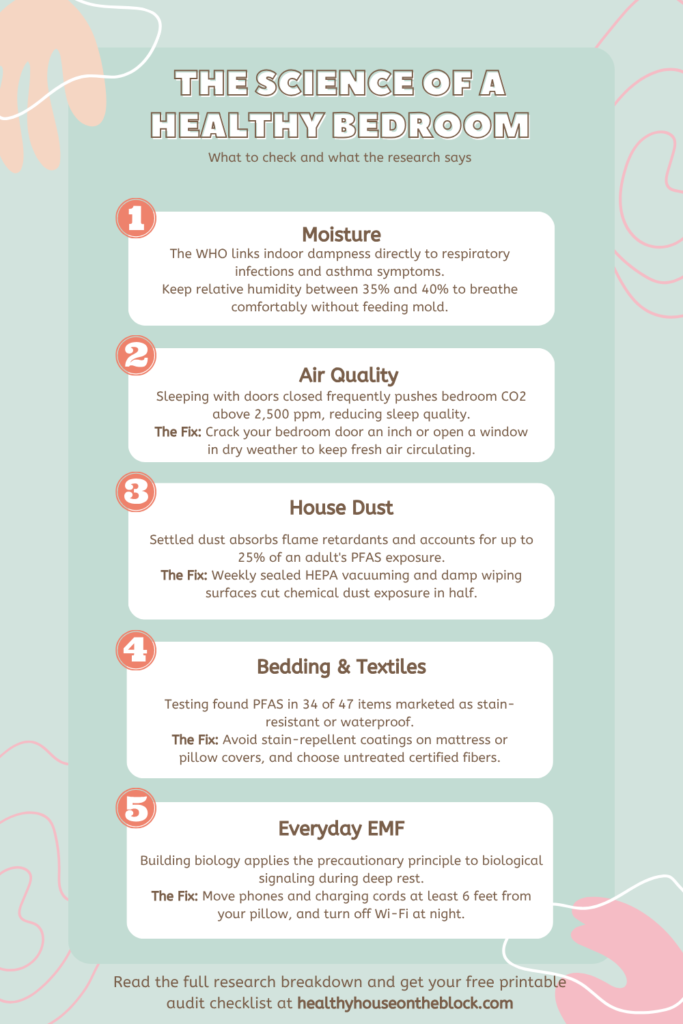
What the research says. The WHO reviewed the evidence and concluded that people living in damp or moldy buildings face a higher risk of respiratory symptoms, respiratory infections, and asthma flare-ups. Because the exact relationship between exposure and effect can’t be pinned down, the WHO points to dampness itself as a strong and consistent indicator of risk and treats moisture as the thing to manage. WHONCBI
The hopeful part. Fixing the problem helps. A Cochrane review found moderate to very low quality evidence that repairing mold-damaged houses and offices reduces asthma-related symptoms and respiratory infections in adults. The earlier version of the review found lower odds of wheezing and rhinitis after home repairs. Cochrane LibraryCochrane Library
Audit it:
- Check the usual hiding spots: exterior walls behind furniture, window sills and frames, closets, under the bed, and around vents.
- Measure humidity. The EPA advises keeping it below 60 percent, ideally between 30 and 50 percent. EPA
- Look for the source of any moisture. The WHO notes that no numeric health-based thresholds can be set for microbial contamination, which is why finding the water matters more than fixating on a single number. WHO
Fix it:
- For small spots on hard surfaces, the EPA advises to clean with water and detergent and dry completely, and discard items that soaked up water. US EPA
- Don’t paint over wet or moldy walls. Fix the water problem first. EPA
- If you find widespread growth, hidden moisture, or mold on porous materials like drywall or insulation, bring in a professional. I go deeper in my posts on how to get rid of house mold and how to fix a damp house.
- If you’re having symptoms you think are mold-related, talk with a healthcare professional. US EPA
Check 2: Fresh air
This one wasn’t on most people’s radar, but it has some of the best sleep-specific research.
What the research says. The Danish study above wasn’t a one-off. In a later field-lab study, sleep quality dropped at ventilation rates producing 1,000 ppm and 1,300 ppm of CO2 compared with 750 ppm. The effect was small but measurable. Closed windows and closed doors matter here, because bedrooms with both closed often reach CO2 levels above 2,500 ppm. ScienceDirectResearchGate
CO2 isn’t the villain itself. Researchers use it as a proxy for how much outdoor air the bedroom is receiving. That makes a CO2 monitor the easiest audit tool you can buy. Taylor & Francis Online
Audit it: Check your monitor first thing in the morning, after a full night with the door closed. If the reading is high, your room isn’t getting enough fresh air.
Fix it:
- Crack a window or the bedroom door at night. The NIH advises to open windows when possible and use kitchen and bathroom exhaust fans to reduce moisture and pollutants. NIH News in Health
- Watch the weather. The EPA advises opening windows only when it isn’t humid outside, so on muggy days, use dehumidification or ventilation instead of pulling in wet air. EPA
Check 3: Household dust
What the research says. Bedroom dust is more than skin cells. One review of six chemical groups found phthalates, flame retardants, bisphenols, PFAS, and biocides in indoor dust, with some banned chemicals like PBDEs and PFOA still widely detected. One 2024 study suggests PFAS in house dust may account for up to 25 percent of an adult’s total exposure. ScienceDirectNational Geographic
Electronics are worth a closer look, since they’re a common source of chemical flame retardants in dust. EWG
The hopeful part. Cleaning works. In a small behavioral study, one week of extra hand washing and dust-focused cleaning cut exposure to some flame retardants by about half. PubMed Central
Audit it: Run a finger across the headboard, nightstands, electronics, and window sills. Then check under the bed and along the baseboards, where dust settles undisturbed.
Fix it:
- A well-maintained HEPA vacuum is the most efficient way to reduce contaminants in dust, at least once a week. Vacuum hard floors too, and don’t just sweep, since sweeping pushes dust around. Toxic-Free Future
- Wipe surfaces with a damp cloth and wet-mop hard floors. The NIH also advises to take your shoes off at the door to avoid tracking in pesticides, dirt, and other pollutants. NIH News in Health
- Consider bare floors or washable rugs. Regular vacuuming removes only about 10 percent of dirt embedded in carpet, which is why hard floors are easier to keep clean. If you have area rugs, flip them over and vacuum the back too. ACS C&ENToxic-Free Future
- Stop dust at the source with a shoes-off routine. My post on healthy house entryway ideas shows how.
Check 4: Textiles and bedding
You spend about a third of your life pressed against your bedding, so what’s in it matters.
PFAS: the strongest evidence. Toxic-Free Future tested bedding, outdoor apparel, and table linens and found PFAS in 34 of 47 items marketed as stain- or water-resistant, and none of the 13 items without those claims. The pattern held up in children’s products too. Silent Spring Institute found PFAS only in products labeled water- or stain-resistant, even those marketed as green or nontoxic, with pillow protectors among the highest. Toxic-Free FutureSilent Spring Institute
These chemicals don’t stay put. PFAS can reach you through inhalation and ingestion of dust, hand-to-mouth transfer, and possibly skin absorption, and treated products shed into dust. That connects this check right back to Check 3. nih
The hopeful part. Safer options exist. Toxic-Free Future found items marketed as stain-resistant that appeared free of PFAS treatments. Toxic-Free Future
Audit it:
- Read the labels on your sheets, comforter, mattress pad, and pillow and mattress protectors. Any “stain-resistant,” “water-resistant,” or “performance” claim is a flag. The NIH also suggests to avoid products marketed as stain resistant. NIH News in Health
- Check for finishing claims like wrinkle-free, which I cover in my natural and organic bedding guide.
Fix it:
- Choose products that explicitly state they are PFAS-free, and look for third-party certifications. GOTS, for example, audits environmental and labor standards from farm through finished product, and MADE SAFE screens finished products for substances of concern. Verify any certificate number on the certifier’s own website.
- Wash new bedding before first use. In one study of clothing, no formaldehyde remained
- in garments after washing. WellnessPulse
What about pesticides in cotton? This is where the science is more nuanced than most wellness content admits. Pesticide residues have been found on cotton in the lab, but no studies show this happening through normal wash, wear, and use, and one study found the dyeing and finishing stages actually remove residues. The same source notes that USDA Organic certification doesn’t cover the dyeing process, which is where many other chemicals come in. Center for Environmental HealthCenter for Environmental Health
So when you shop, look for certifications that cover how the fabric was processed, not just how the cotton was grown. Organic farming still matters for farmworkers and the environment, but for your own exposure, PFAS and finishing chemicals deserve more of your attention than farm pesticides. If your budget is tight, this is a good place to prioritize: replace stain-resistant items first, and don’t stress about conventional cotton.
Check 5: EMF
This is where building biology and mainstream science part ways, so I’ll be upfront.
Building biology guidelines are precautionary and set well below government limits. The two approaches answer different questions: government limits protect against proven thermal effects, while building biology guidelines apply the precautionary principle to exposures that may have biological effects below that threshold. Hbelc
What the research says. The experimental evidence on sleep is mixed. A WHO-commissioned systematic review of human experiments found no measurable effect of RF exposure on sleep disturbances. A Swiss cohort study reached a similar result, finding no evidence of adverse effects on sleep quality from everyday RF exposure. Other researchers note that some reviews report changes in brain activity when pulse-modulated RF is given right before or during sleep, and that results vary widely with study design. The effects of radiofrequency electromagnetic fields exposure on human self-reported symptoms: A systematic review of human experimental studies – ScienceDirect +2
In short, harm isn’t proven, but the question isn’t fully closed either. Building biology treats sleep as the place to be cautious, especially when the steps are cheap.
Audit it and fix it, low-cost steps first:
- Building biology guidance recommends to eliminate, minimize, or shield from RF sources, avoid metal bed frames and box springs, and check for elevated magnetic fields from appliances and wiring. Buildingbiologyinstitute
- Turn off your Wi-Fi router at night. It’s one of the free steps building biology practitioners list first.
- Move phones, chargers, and clocks away from the bed. My posts on the EMF-free bedroom and what EMF protection actually means walk through this.
- If you want real numbers rather than guesses, a building biology assessment measures electric fields, magnetic fields, and RF at the sleeping position.
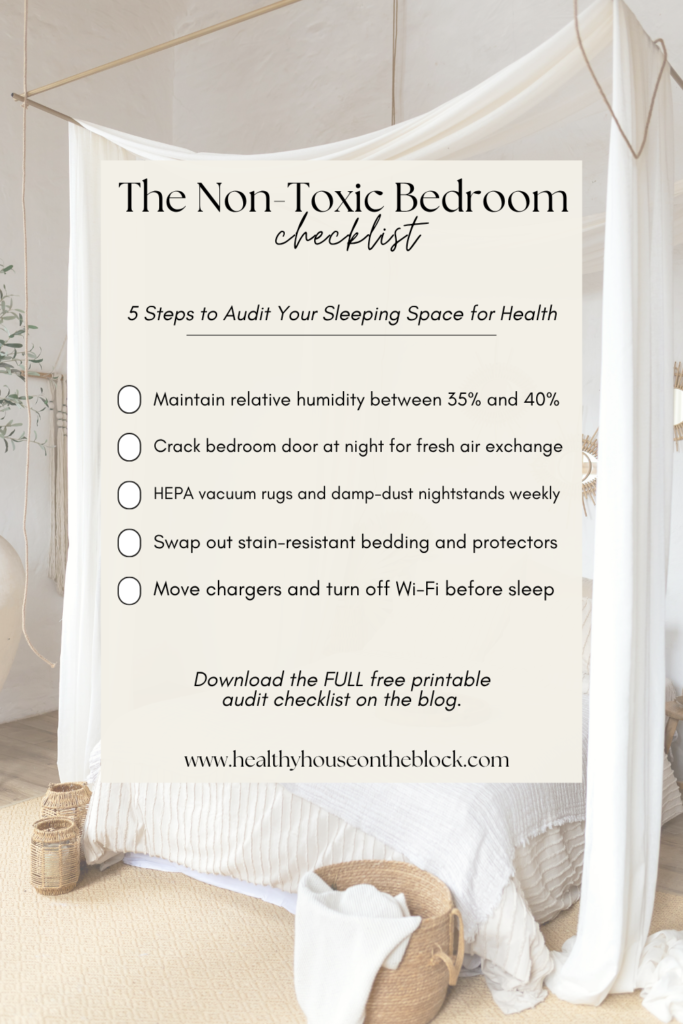
Your non-toxic bedroom checklist
Print this or save it to your phone.
Mold and moisture
- Sniffed for musty odor and checked corners, closets, and under the bed
- Bought or checked a hygrometer (target: under 60%, ideally 30–50%)
- Fixed any leaks or condensation sources
Fresh air
- Checked CO2 in the morning
- Cracked a window or door at night when the weather allows
Dust
- HEPA-vacuumed floors, rugs, and under the bed
- Damp-dusted headboard, nightstands, and electronics
- Set up a shoes-off routine
Textiles and bedding
- Checked labels for stain-resistant, water-resistant, or wrinkle-free claims
- Swapped out any treated pillow or mattress protectors
- Washed new bedding before first use
EMF
- Turned off Wi-Fi at night
- Moved phones and chargers away from the bed
- Checked for a metal bed frame and electronics near the pillow
Where to start
- This week (free): Do the walk-through, check humidity, crack a window, damp-dust and vacuum, turn off the router, and move the phone.
- This month: Replace any stain-resistant bedding and protectors, and buy a CO2 monitor if you haven’t.
- Ongoing: Fix any moisture source you found, and choose PFAS-free options as you replace items.
You don’t need to do everything at once. Each check you complete makes your sleeping space better. For the rest of the house, see my guide to non-toxic house ideas.
FAQ
What is building biology?
It’s a holistic approach to healthy buildings, based on 25 principles that cover everything from materials to indoor air, with the sleeping area as a priority. Practitioners often use measurements to guide decisions. Buildingbiology
What humidity level is best for a bedroom?
The EPA recommends below 60 percent, ideally 30 to 50 percent, measured with an inexpensive hygrometer. EPA
Is organic cotton bedding worth it?
For your own exposure, PFAS and finishing chemicals matter more than farm pesticides, since pesticide residues in cotton products haven’t been shown to be a significant source of exposure. Organic still supports farmworkers and the environment. Prioritize PFAS-free, certified products. Center for Environmental Health
Should I turn off Wi-Fi at night?
The research is mixed, and harm to sleep hasn’t been proven. Building biology recommends it as a free, precautionary step, and there’s little downside to trying it.
How often should I vacuum and dust my bedroom?
Aim for a HEPA vacuum at least once a week, plus regular damp dusting of surfaces and electronics. Toxic-Free Future
How do I know if my bedroom has mold?
Look for the WHO’s indicators: condensation, visible mold, a mold odor, and past water damage. If you suspect hidden mold or have symptoms, involve a professional and a healthcare provider. WHO

Ready to take the next step?
You can run this audit on your own. If you’d like a guided path, my mini course Sleep Sanctuary walks you through creating a healthier bedroom step by step. If you’d rather have someone assess your actual space, book a consultation and we’ll build a plan around your home.
This post is for education and isn’t medical advice. If you have health symptoms, talk with your healthcare provider.