It usually happens on a rainy afternoon or after a humid stretch of summer. You walk into the guest bedroom, open the cabinet under the kitchen sink, or step into the basement, and there it is—that unmistakable, earthy, damp scent.
For many homeowners, the first instinct is to reach for a scented candle or a plug-in air freshener to mask the odor. But as a building biology practitioner, I want to invite you to look at that scent differently. That smell isn’t just a nuisance; it is a biological signal. It is the sound of your home “talking” to you about its internal health.
That scent is actually the presence of mVOCs, or Microbial Volatile Organic Compounds. Understanding what they are—and how they impact your family’s long-term wellness—is one of the most empowering steps you can take in creating a truly healthy home.
What Exactly are mVOCs?
While standard VOCs (Volatile Organic Compounds) usually come from synthetic sources like new furniture, “fresh” paint, or cleaning chemicals, mVOCs are the metabolic byproducts of mold and bacteria.
Think of it this way: Microbes are living organisms. To survive and colonize, they need two things: a food source and moisture. In our homes, “food” is everywhere—it’s the paper facing on your drywall, the dust in your HVAC vents, the wood studs behind your shower, and even the natural fibers in your rugs.
As these microbes “digest” these materials, they undergo a metabolic process. Much like humans exhale carbon dioxide, mold and bacteria exhale a cocktail of gases. These gases are mVOCs.
Because these are gases, not heavy particles, they move freely through the “building envelope.” They can pass through porous drywall, seep under flooring, and travel through insulation. This is why you can often smell a problem in a room even if there is no visible mold on the walls. It is also why simply “cleaning” the surface of a wall often doesn’t stop the smell; the source is frequently embedded deep within the material.
Musty Smell in House Health Symptoms: Beyond the Lungs
In my work with health-focused families at Healthy House on the Block, I often see a disconnect between a “smelly room” and the physical symptoms the family is experiencing. It is vital to differentiate between the short-term warnings and the long-term systemic impacts of these microbial gases.
Acute (Short-Term) Symptoms
These are the body’s immediate “alarm bells.” When you enter a space with high mVOC concentrations, your body may react almost instantly:
- Respiratory Irritation: Sudden sneezing, runny nose, or a scratchy throat that appears only in certain rooms.
- Neurological Spikes: Sudden headaches, pressure behind the eyes, or dizziness.
- Cognitive Fog: A sense of “brain fog” or difficulty concentrating that seems to lift within an hour of being in fresh outdoor air.
Chronic (Long-Term) Impacts and Neurotoxicity
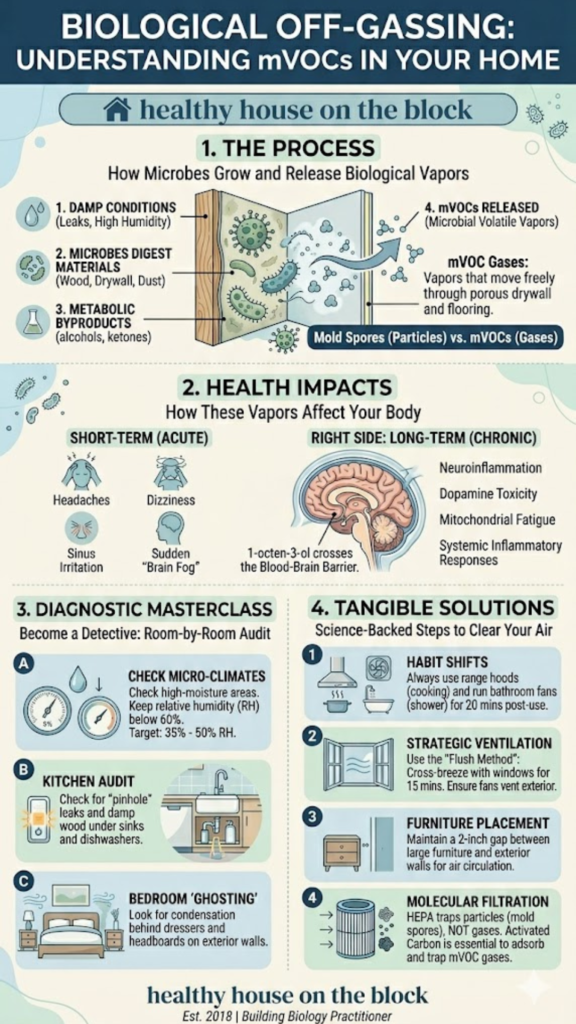
This is where the science becomes truly important for the long-term wellness of your family. Research has centered on specific compounds like 1-octen-3-ol, which is frequently found in damp indoor environments.
Because these molecules are incredibly small, they can bypass our body’s standard filtration systems. Studies have shown that 1-octen-3-ol has the ability to cross the blood-brain barrier. Chronic inhalation has been linked to:
- Neuroinflammation: The gases can induce toxicity in dopamine neurons, leading to persistent neurological fatigue and mood shifts.
- Mitochondrial Dysfunction: Emerging research suggests that prolonged exposure to microbial gases can interfere with how our cells produce energy, leading to a feeling of being “run down” regardless of sleep.
Systemic Inflammation: For those with sensitive constitutions or genetic predispositions (like those sensitive to Chronic Inflammatory Response Syndrome), these gases keep the immune system in a state of high alert.
Become a Building Biology Detective: A Home Audit Masterclass
If you’ve noticed a scent, the next step is locating the source. I recommend a “room-by-room” audit using your senses and a few simple tools. This is a core part of the deep-dive work we do in the Healthy Home Blueprint.
The Kitchen Audit
The kitchen is a high-moisture zone. Check under the sink for slow “pinhole” leaks in the plumbing that might be soaking the cabinetry wood. Even a damp rag left at the back of a dark cabinet can become a source of mVOCs.
- The Check: Use a moisture meter on the base of your cabinets. If the wood feels soft or the meter spikes, you have an active source.
- The Solution: Use a leak alarm under the sink and ensure the area under the dishwasher is dry.
The Bedroom Audit
We spend a third of our lives in our bedrooms, making air quality here a priority for cellular repair.
- The Check: Pull your headboard or dresser away from the wall. If the wall feels cold or damp, you may have “ghosting”—where moisture from the air condenses on the cold surface, feeding microbes on the drywall paper.
- The Solution: Ensure air can flow behind large furniture. Never push furniture flush against an exterior wall.
The HVAC Audit
Your heating and cooling system acts as the “lungs” of your home. If there is moisture in the coils or the drain pan, the system will blow mVOCs into every room.
- The Check: Have a professional inspect your coils annually for “dirty sock syndrome,” a common term for microbial growth on the system components.
- The Solution: Ensure your condensate drain line is clear and your filters are changed regularly with high-quality media.
The Building Biology Approach: Detailed Solutions
Empowerment comes from knowing how to address the root cause, not just the symptom.
1. Master Your Humidity Habits
Microbes generally begin to thrive when relative humidity stays above 60%.
- The Diagnostic Tool: I recommend keeping a small, calibrated hygrometer in “high-risk” areas.
- The Solution: Aim for a “sweet spot” of 35% to 50% humidity. If a room is consistently hitting 60%, a high-quality dehumidifier is your first line of defense to “starve” the microbes of the moisture they need to metabolize.
2. Strategic Ventilation (Dilution is the Solution)
Modern homes are often built to be “airtight” for energy efficiency, but this can trap musty smell in house health symptoms inside.
- The “Flush” Method: On days with low outdoor humidity, open windows at opposite ends of the house for 15-20 minutes. This creates a cross-breeze that physically flushes out accumulated gases.
- Mechanical Help: Ensure your bathroom fans and range hoods are actually venting to the exterior of your home, not just into the attic or joist spaces.
3. Molecular Filtration: Why HEPA is Not Enough
A common mistake I see is families investing in HEPA filters to get rid of odors.
- The Difference: HEPA filters are designed for particulates like spores and dust. They are like nets that catch solid objects.
- The Gas-Phase Solution: To remove gases like mVOCs, you must have activated carbon. Carbon works through adsorption, where the gas molecules are chemically trapped in the tiny pores of the carbon.
- What to Look For: Look for a purifier with a “deep bed” of activated carbon (ideally several pounds) rather than a thin carbon-coated sheet.
4. Low-Toxin Habits and Avoidance
Avoidance is the strongest tool in your healthy home toolkit.
- Stop the Masking: Never use synthetic fragrances to cover a musty smell. These often contain phthalates that add to the “chemical soup” your body has to process.
- Smart Cleaning: Use botanical, non-toxic surfactants to clean surfaces. If a scent persists after cleaning, it is a sign that the moisture source is still active and needs professional attention.
Creating Your Sanctuary
Finding a musty scent in your home can feel overwhelming, but it is actually an opportunity. It is your home giving you the information you need to protect your family’s health. By shifting your habits and focusing on proper filtration, you are moving away from “masking” problems and toward a foundation of true, science-based wellness.
- Research published in NeuroToxicology highlights the specific pathway of 1-octen-3-ol in inducing toxicity within dopamine neurons. These studies provide the biological basis for the neurological symptoms often reported by individuals living in damp indoor environments.
- For more on the building biology principles of air exchange and moisture control, visit the Building Biology Institute.