As a Building Biology practitioner, I often speak with homeowners who are caught in a difficult position. On one hand, you want to be a good steward of the earth and provide a sustainable, renewable future for your family. On the other, you’ve heard whispers that solar panels might not be as “clean” for our internal environment as they are for the planet.
If you’ve felt that conflict, I want to reassure you: solar energy and a healthy home can absolutely coexist. The goal of this guide isn’t to turn you away from renewable energy. Instead, we are moving away from the ‘standard’ installation—which prioritizes cost and speed—and toward a biologically compatible system. Today, we’re doing a deep dive into the health impacts of solar panels and how you can harness the sun without compromising your wellness.
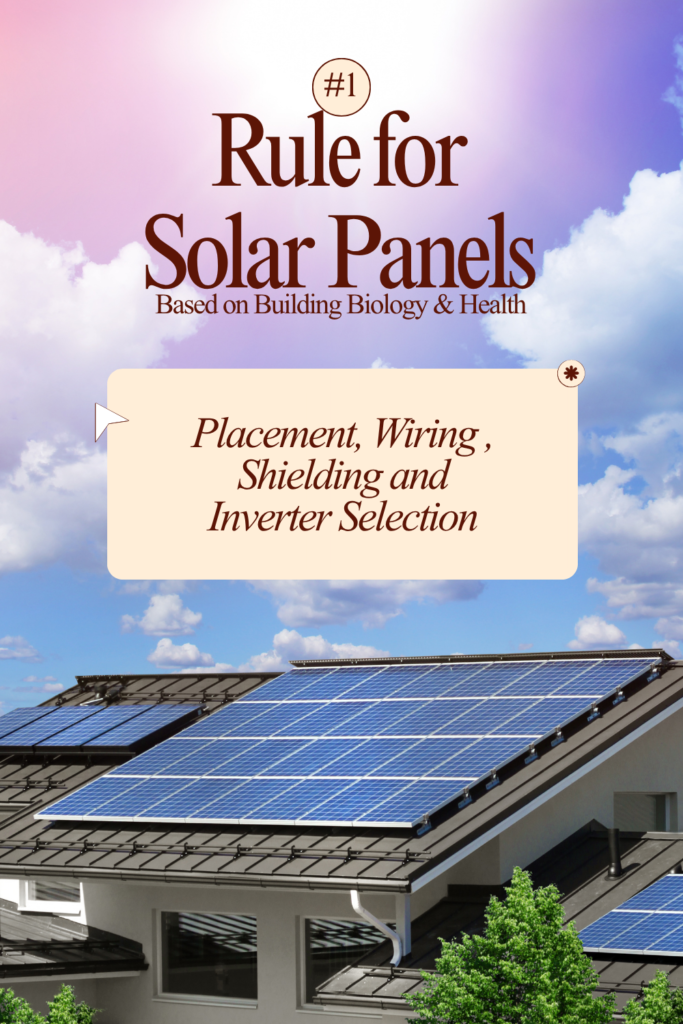
Health Impacts of Solar Panels: A Building Biologist’s Guide to Healthy Solar Energy
In the mainstream eco-conscious movement, the focus is almost exclusively on the carbon footprint. We ask, “How much CO2 am I saving?” and “What is my payback period?”
But in Building Biology, we prioritize the biological footprint. We ask, “How does this technology affect the cellular health of the people living inside?”
Most solar systems are designed for maximum energy efficiency, but they rarely account for their impact on the human nervous system. When we look at solar through a health lens, we aren’t just looking at the panels on the roof; we are looking at how that energy is converted, manipulated, and moved through your home’s wiring. The “eco-friendly” label is a great start, but it doesn’t guarantee that a product is compatible with human physiology.
The Science Behind the Health Impacts of Solar Panels
To understand the health impacts, we have to look at the “transformation” process. Solar panels generate Direct Current (DC). Our homes, however, run on Alternating Current (AC). To bridge this gap, every solar system requires an inverter. This device is the “brain” of the system, but it is also the primary source of environmental stressors.
1. Microsurge Electrical Pollution (Dirty Electricity)
The inverter uses a process called High-Frequency Switching to “chop” DC power into an AC wave. This process is inherently “noisy.” It creates high-frequency voltage transients, often referred to as Dirty Electricity or EMI (Electromagnetic Interference).
Instead of a smooth, clean 60Hz sine wave, your wiring becomes flooded with “spikes” of high-frequency energy. This noise doesn’t stay contained in the inverter; it hitches a ride on your home’s copper wiring, radiating into your living spaces like a low-level radio transmitter.
The Research: Pioneering work by researchers like Dr. Samuel Milham has linked chronic exposure to these voltage transients to “diseases of civilization.” His studies suggest that these frequencies can interfere with mitochondrial function and metabolic health. Because these frequencies are much higher than the standard 60Hz your body is used to, they can act as a subtle, constant irritant to your cells.
2. Magnetic Fields and Current Loops
A common oversight in solar installations is the creation of “objectionable current.” Large solar arrays involve long runs of cabling. If these cables aren’t managed correctly, they can create large “loop areas” that generate elevated magnetic fields.
According to the Building Biology Institute, magnetic fields are particularly concerning because they are nearly impossible to shield with standard building materials like drywall or wood. These fields can pass directly through walls and into your body, potentially disrupting the natural magnetic orientation of your cells and interfering with melatonin production.
3. Radio Frequency (RF) and “Smart” Monitoring
To satisfy the demand for data, many modern systems use microinverters or wireless power optimizers. These devices communicate via Zigbee, Wi-Fi, or cellular signals. This adds a layer of “electrosmog” directly on your roof. Rather than having one centralized source of power, you essentially have 20 to 30 small radio transmitters positioned right above your head, pulsing data throughout the day.
How Solar Stress Affects Your Nervous System
Our bodies are exquisitely sensitive electrical beings. Every thought, muscle contraction, and heartbeat is a biological electrical signal. When we surround ourselves with the high-frequency “noise” of dirty electricity or elevated magnetic fields, our nervous system perceives it as a stressor.
The SBM-2015 Building Biology Standard takes a precautionary approach to these exposures. Even if you don’t consider yourself “electrosensitive,” this invisible noise can keep your body in a “fight or flight” (sympathetic) state. Over time, this makes it difficult for the body to drop into the “rest and digest” (parasympathetic) state required for deep, restorative sleep and cellular repair.
A Step-by-Step Guide to a Healthy Solar Installation
You can have the benefits of solar without the biological stress. Here is how we design a system that aligns with Building Biology principles:
Step 1: Prioritize Distance (The Inverter Location)
In EMF mitigation, the “Inverse Square Law” is our best friend: as you double your distance from a source, your exposure drops significantly.
- The Rule: The inverter and battery storage should never be mounted on a wall shared with a bedroom, nursery, or primary living space.
- The Solution: Ideally, install these components on a detached structure (like a shed) or a far exterior wall of a garage. The goal is to keep the “noisy” equipment as far from the “sleeping sanctuary” as possible.
Step 2: Choose String Inverters Over Microinverters
From a health perspective, string inverters are almost always the better choice.
- Why: A string inverter centralizes the conversion process in one box, which we can then place in a safe, distant location.
- The Alternative: Microinverters place a source of dirty electricity and RF radiation directly under every single panel. This turns your entire roof into an active source of interference. By choosing a central string inverter, we keep the “messy” electricity localized and manageable.
Step 3: Use Shielded Cabling
Ask your installer to use Metal Clad (MC) cable or rigid metal conduit for all AC runs coming from the inverter. Standard plastic-jacketed Romex does nothing to block electric fields. Metal shielding helps contain the electric fields and can reduce the “broadcasting” of dirty electricity throughout the house.
Step 4: Hardwire Your Monitoring
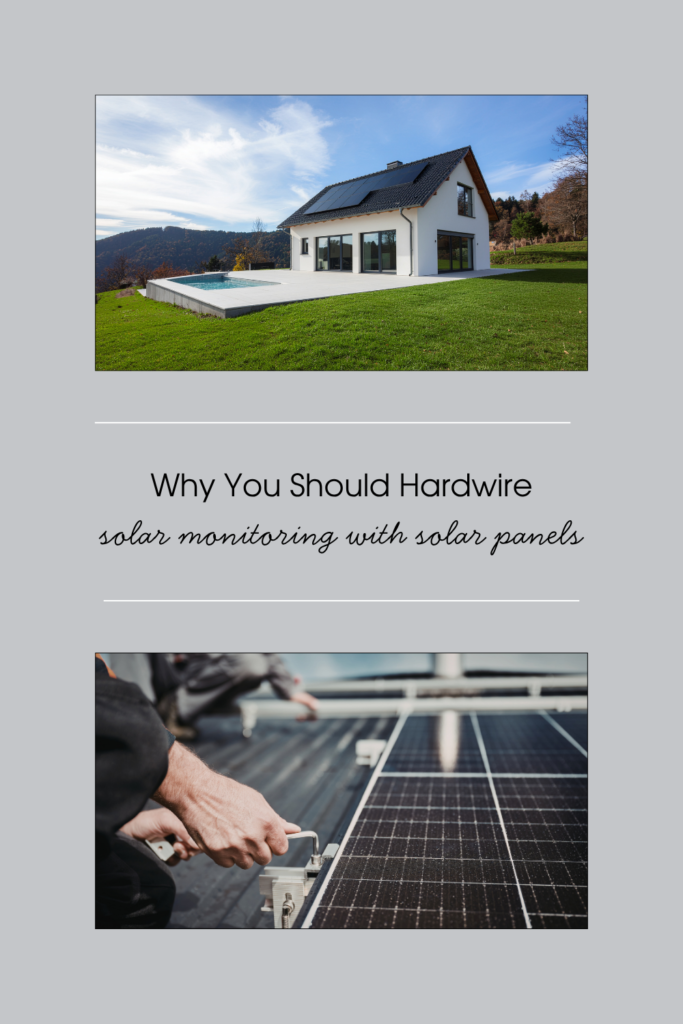
Most solar installers will try to set up your monitoring via Wi-Fi for convenience. However, most quality inverters (like SMA or Fronius) have an Ethernet port. Request that your installer runs a shielded Cat6 Ethernet cable from your router to the inverter. This gives you all the energy data you want with zero added RF radiation in your home.
Step 5: Address Grounding and Magnetic Loops
Ensure your installer follows “twisted pair” or “closely bundled” wiring techniques for DC runs. This minimizes the loop area and significantly reduces the magnetic field produced by the system. It is also vital to ensure that the solar system does not create a “ground loop” with your home’s existing electrical panel, which can cause current to flow on your metal water pipes.
Step 6: Clean Up with Filtration
Once the system is physically optimized, we can look at remediation. High-quality filters, such as those from Greenwave, can be installed to help “mop up” any remaining high-frequency transients that the inverter pushes into the home’s wiring.
I always tell my clients: Filtration is the finishing touch, not the foundation. We don’t use filters to fix a poorly designed system; we use them to perfect a well-designed one.
Building a Legacy of Health
Creating a healthy home is about layers of protection. Understanding the health impacts of solar panels is the first step toward creating a truly sustainable sanctuary. Solar is a wonderful resource, and when implemented with these biological safeguards, it can truly support both the health of the planet and the health of your family.
You don’t have to navigate these technical decisions alone. Every home has a unique ‘electrical signature,’ and I am here to help you ensure your transition to renewable energy is as supportive as possible.