
As a building biologist and home inspector, one maintenance chore comes up with my clients more than almost any other: air duct cleaning.
Most of us dread thinking about it. Ductwork is out of sight, it’s an investment with zero aesthetic payoff, and wondering what might be lingering inside those dark metal tunnels is unsettling.
Think of your HVAC system as the respiratory tract of your house. It pulls in air from your living spaces, conditions it, and delivers it right back into your bedrooms, kitchen, and nursery. When ductwork is coated in fine particulate, chemical residues, or biological growth, those exact particles recirculate through your family’s personal breathing space every time the fan kicks on.
If your air filter seems to get dark, fuzzy, and clogged every few weeks, your system is trying to tell you something.
Because navigating HVAC maintenance and contractor estimates can feel overwhelming, I’m hosting an interactive Live Air Duct and HVAC Wellness Workshop to walk you through your home’s setup step by step. You can join me live to audit your own system, spot contractor red flags, and ask your questions directly. You’ll find all the details to claim your seat at the bottom of this post.
Let’s dig into what’s really happening inside your vents, the science behind household dust, and how to know when professional cleaning is truly worth the investment.
Why Indoor Dust Is Toxic to Your Health
Dust is far more than an annoying chore that makes you reach for the microfiber cloth on a Saturday morning. In building biology and environmental medicine, indoor dust is recognized as a major reservoir and collection sink for environmental toxins.
Household dust behaves like a magnet. It holds onto shed fibers, sloughed skin cells, and microscopic chemical particles that migrate out of everyday consumer products, building materials, and furnishings.
Synthetic Chemicals and Endocrine Disruptors
Dust contains loose microfibers that shed from synthetic wall-to-wall carpets, upholstered sofas, and foam cushions. The chemicals applied to those textiles don’t simply vanish. They break down into microscopic debris that settles into our living spaces and return grilles.
Dr. Veena Singla and a team of researchers from George Washington University, the Silent Spring Institute, and Harvard collaborated on a comprehensive study on toxic chemicals in indoor dust published through the NRDC. Their analysis revealed that indoor house dust across the United States contains an alarming brew of hazardous compounds:
- Flame Retardants: Added to furniture foam, electronics, and insulation, these organophosphates are associated with neurodevelopmental harm and endocrine disruption.
- Phthalates: Plasticizers found in flexible vinyl flooring, shower curtains, and synthetic fragrances that interfere with hormone regulation.
- PFAS and Fluorinated Compounds: Stain repellents used on carpets and upholstery that persist indefinitely in both the human body and the home environment.
- Phenols and Formaldehyde: Byproducts of conventional cleaning agents, pressed wood cabinetry, and laminate glues.
These chemical classes are well-documented hormone and endocrine disruptors. Because children spend so much time playing on the floor, frequently putting their hands in their mouths, their exposure to contaminated dust per pound of body weight is significantly higher than that of adults.

Pesticides and Heavy Residues
Pesticides don’t stay outside on the lawn. Studies on residential chemical migration show that outdoor pesticides, weed killers, and agricultural chemicals are routinely tracked inside on the bottoms of our shoes.
Once inside, these heavy chemical particles settle into carpet pile and return air pathways. Breathing in these fine particulate complexes can lead to respiratory irritation and increased systemic toxic load. Research exploring environmental exposures in children highlights connections between household pesticide exposure and childhood developmental vulnerabilities and immune disruption, alongside dermal irritation and chronic inflammation.
When your home has excess dust moving through the ventilation system, your family is breathing in far more than simple outdoor soil.
Frequently Dirty Air Filter? Here Is What Is Actually Happening
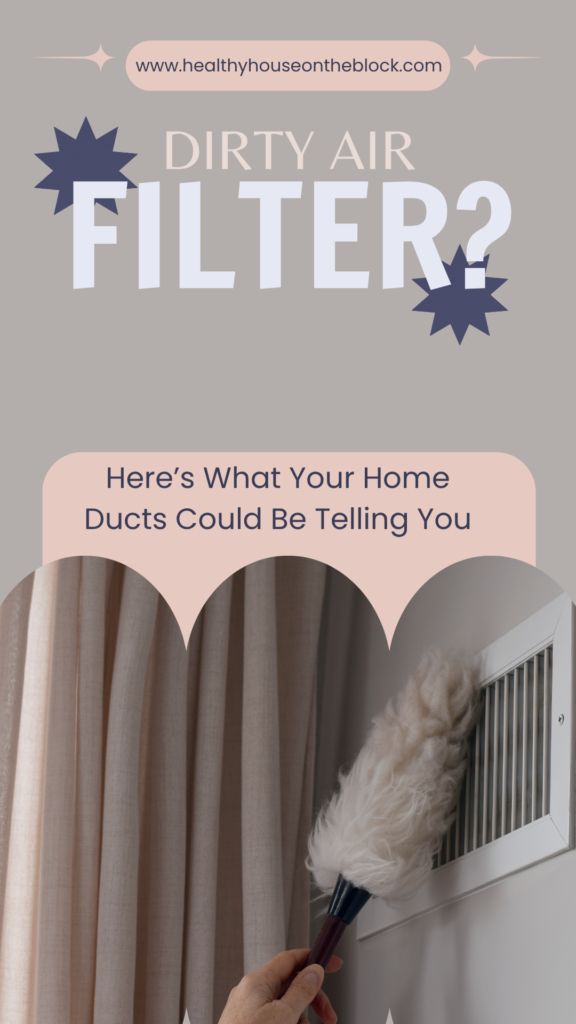
If your furnace filter is coated in dark dust every single month, it’s very natural to assume that your supply ducts are filthy and blowing dirt onto the filter.
Mechanically, the air cycle moves in the exact opposite direction.
Your furnace filter sits on the return side of your HVAC system, directly upstream of the blower cabinet and heat exchanger. Its job is to capture particulate matter coming out of your living spaces before that air passes through your equipment.
If your air filter gets dirty at an unusually rapid rate, building biology points to a few hidden root causes:
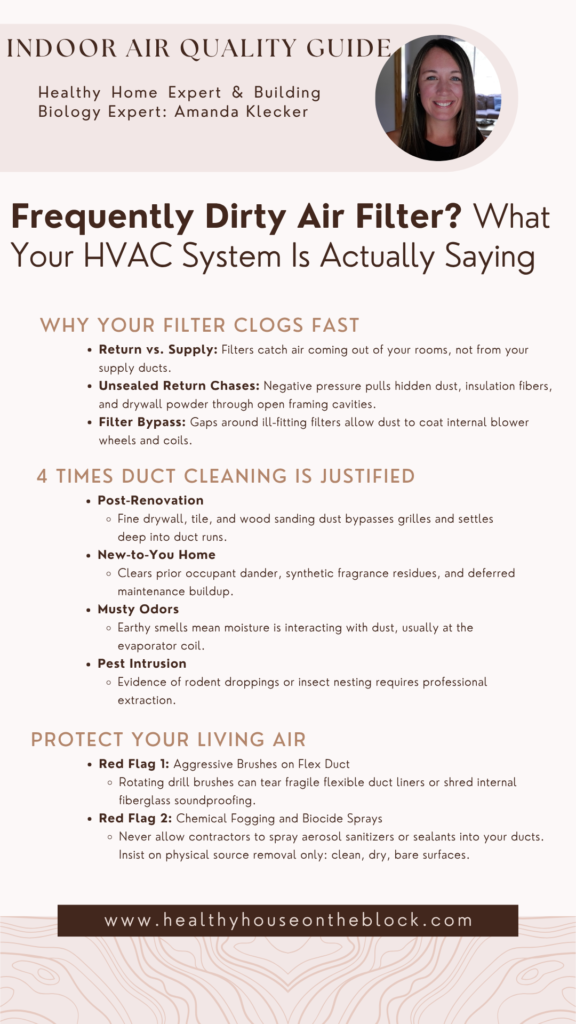
- Unsealed Return Air Cavities: In many homes, return ducts aren’t continuous metal pipes. Instead, builders often use open wall studs or joist bays, known as panned returns. Because the return side is under negative pressure, it acts like a giant vacuum, sucking in whatever is nearby. If those return cavities have gaps, cracks, or unsealed seams, they’ll pull in years of cellulose insulation, drywall powder, and dust from inside wall cavities, dirty basements, or unconditioned attics.
- Filter Bypass: If your filter doesn’t fit snugly in the track, if it bows under the pressure of the fan, or if there’s no gasket sealing the perimeter, air takes the path of least resistance. Dusty air simply slips around the edges of the filter. That bypass dust deposits directly onto your fan wheel and air conditioning evaporator coil, eventually settling down into your supply ducts.
- High Indoor Particulate Generation: Living near a busy roadway, burning candles or incense, frequent indoor cooking without turning on a vented range hood, or having multiple pets can saturate your indoor air with fine particulate that rapidly coats your filter.
Replacing your dirty filter is an essential step, but if the return runs are pulling dust from inside the building cavities, the filter will continue to clog until those return chases are sealed.

Clear Signs It Is Time to Have Your Air Ducts Cleaned
According to indoor air quality guidelines published by the EPA, air duct cleaning shouldn’t be a routine service you purchase every year on a whim. In building biology, we believe in condition-based interventions.
You should consider hiring a certified professional when you observe clear physical indicators:
- You’ve Recently Completed a Home Remodel: Drywall dust, tile cutting, wood sanding, and framing generate ultra-fine construction dust. Even if you were very careful to tape off doorways and put drop cloths down, fine mineral dust finds its way into return vents. Construction dust contains silica and synthetic binders that irritate delicate lung tissue and should be physically removed.
- You Just Moved into a New-to-You Home: You simply can’t know the lifestyle habits of previous occupants. Did they own three long-haired dogs? Did they use aerosol air fresheners, incense, or plug-ins? Did they neglect filter changes for years? Having your HVAC system thoroughly cleaned gives your family a clean baseline.
- Musty Odors or Earthy Smells From the Registers: If your vents give off a sour, musty, or earthy odor whenever the air conditioner or fan starts running, moisture is interacting with accumulated organic debris. This is a clear indicator that biological growth may be present in the air handler or ductwork.
- Visible Mold Growth Inside Vents: If you shine a flashlight into your supply boots or look at your register louvers and see black, green, or fuzzy spotting, you need professional remediation. In an HVAC system, surface mold almost always points back to high relative humidity or a dirty, waterlogged evaporator coil.
- Evidence of Pest or Rodent Activity: Rodents, squirrels, bats, or insects occasionally find their way into duct chases. If there are droppings, nesting materials, or insect debris inside your ductwork, the system requires immediate professional extraction and sanitation.
- Restricted, Uneven Airflow Across Rooms: When blower wheel fan blades become caked with dust or the delicate fins of the evaporator coil get matted with pet hair, airflow drops dramatically. Cleaning the entire mechanical air path restores balanced air delivery and relieves stress on your blower motor.

The Evaporator Coil: Where the Real Mold Grows
When homeowners notice a sour or musty smell coming from their vents, they usually assume the metal supply ducts are full of mold.
In most forced-air systems, sheet metal ducts are dry environments where mold can’t easily proliferate unless there’s active water penetration or roof condensation.
The primary biological hotspot inside an HVAC system is the air conditioning evaporator coil and condensate drain pan.
During the cooling season, your evaporator coil gets very cold, pulling warm, humid air across its aluminum fins to condense water vapor out of the air. That condensed moisture drips down into a drain pan and flows through a drain line.
If your air filter allows dust to bypass, that organic house dust coats the wet aluminum fins. Organic dust plus continuous moisture equals the perfect environment for mold and bacterial biofilms. Every cubic foot of air your system delivers must pass directly through that wet, dirty coil before reaching your rooms.
When hiring a duct cleaning company, verifying that they’ll physically clean and rinse the evaporator coil and clear the condensate drain line is just as critical as cleaning the ducts themselves.
Two Mistakes Homeowners Make With Duct Cleaning
Before you call a local company, there are two crucial building biology cautions you must keep in mind:
1. The Wrong Cleaning Method Can Ruin Your Ducts
How your ducts are constructed matters immensely. While rigid galvanized sheet metal can easily handle stiff rotary brushes, flexible ductwork and internally lined fiberglass duct board require entirely different care. Using aggressive mechanical brushes on flex duct or porous acoustic liners can tear the inner vapor barrier or shed microscopic fiberglass particles straight into your living areas. The cleaning method must strictly match your duct material.

2. Never Allow Chemical Fogging or Biocides
Many duct cleaning contractors will try to upsell an aerosol biocide, sanitizing fog, or chemical sealant at the end of the appointment.
In building biology, we strongly advise against allowing chemical fogging agents or synthetic disinfectants inside your ductwork. These chemicals linger, adhere to leftover dust, and off-gas directly into the air your family breathes while sleeping. Proper duct cleaning is about physical source removal, meaning mechanical extraction until surfaces are clean and dry, with zero added chemical residues.

Learn How to Audit Your HVAC and Hire Safely
Understanding your home’s ductwork doesn’t have to feel like guesswork, and you don’t have to risk hiring the wrong contractor or breathing in harmful chemical treatments.
To help you protect your home’s air pathways with confidence, I’m hosting a Live Air Duct and HVAC Wellness Workshop.
In this live, interactive workshop, we’ll dive into the practical tools and visual guides that go beyond this blog post:
- Visual Duct Identification: How to tell if your home has sheet metal, flex duct, or fiberglass duct board, and the exact cleaning methods each one requires
- Contractor Screening Checklist: The exact questions to ask potential duct cleaning companies, how to read their estimates, and how to spot hidden chemical upcharges
- Coil and Grille Maintenance: My low-toxin protocol for keeping your registers, return boots, and evaporator coils clean without specialized equipment
- Live Q&A: A dedicated session where you can bring photos of your furnace, duct runs, or contractor quotes to get direct answers for your specific home
If you’re ready to take the guesswork out of your HVAC maintenance and create a truly healthy respiratory system for your home, I’d love to have you join us.



Pingback: The Health Hazards Lurking in Your Home: Can Dirty Air Ducts Make You Sick?