The kitchen is often called the heart of the home, but in my work as a building biology practitioner, I have come to see it as something even more significant. It is the primary interface between your home’s environment and your family’s biology. Every time you boil water, open the dishwasher, or flip on those bright overhead lights to prep dinner, your body is responding to its surroundings.
Most of us know that a damp basement or a visible leak is a problem. However, it is the invisible, everyday rhythms in our kitchens that often have the greatest impact on how we feel. When we ignore the steam rising from the stovetop or the lingering moisture in the sink drain, we are not just risking a bit of mold; we are asking our immune and nervous systems to work overtime. By shifting just a few small habits, you can transform your kitchen into a healthy kitchen that actively supports your hormones, your sleep, and your long-term vitality.
The Science of Your Indoor Environment: The Deep Why
Before we dive into the habits, it is important to understand what is happening at a cellular level. Your home environment communicates with your body in several profound ways that go far beyond simple respiratory irritation.
Systemic Inflammation and the Bloodstream
When we cook without proper ventilation, we release fine particulate matter, known as PM2.5. These particles are so small—about 1/30th the width of a human hair—that they travel deep into the lungs and can translocate directly into your bloodstream (Nemmar et al., 2002). Once there, they trigger a systemic inflammatory response, increasing markers like C-reactive protein (Thangavel et al., 2022).
Recent research suggests that chronic exposure to these particles can even lead to blood-brain barrier disruption and neurotoxic consequences (Amnuaylojaroen & Parasin, 2024). By maintaining a healthy kitchen through air filtration and ventilation, you are protecting more than just your lungs; you are protecting your cardiovascular and neurological health.

Hormonal and Endocrine Health
The kitchen can be a significant source of volatile organic compounds (VOCs) and endocrine disruptors. These “hormone mimics” can interfere with the delicate signaling of your thyroid and adrenal glands. This is especially important for women, whose endocrine systems are highly sensitive to environmental triggers. Managing air quality and moisture is a foundational step in protecting your body’s chemical communication system.
The Nervous System and Circadian Rhythm
Your nervous system is constantly scanning for environmental cues. High-energy blue light from overhead LEDs signals “high noon” to your brain, which suppresses melatonin production (West et al., 2011). This keeps you in a state of sympathetic dominance, or the “fight or flight” mode. Shifting your environment to mimic natural light cycles helps your body transition into the parasympathetic state, which is essential for proper digestion, hormone regulation, and cellular repair (Wahl et al., 2019).

The Biological Impact: Why We Target Specific Toxins
To truly create a healthy kitchen, we must look at the specific stressors that common habits can introduce.
- Mycotoxins and Immune Suppression: When mold grows in a damp cabinet or a dishwasher seal, it doesn’t just stay there. It can release mycotoxins into the air. These secondary metabolites are known to have immunomodulatory properties, potentially suppressing the immune system and making individuals more susceptible to infections (Mafe & Büsselberg, 2024; Kraft et al., 2021).
- Biofilms in Water Systems: The “sludge” you might find in a sink drain or a faucet aerator is often a complex community of bacteria and mold known as a biofilm. These films are resistant to simple rinsing and can aerosolize bacteria every time you run the water, contributing to the “antigenic load” your immune system has to manage.
- Particulate Matter (PM2.5): Beyond just smoke, cooking oils heated to their smoke point release acrolein and other harmful particulates. In a kitchen without a vented hood, these levels can quickly exceed safe limits, causing immediate oxidative stress in the body (Amnuaylojaroen & Parasin, 2024).

Essential Habits for a Healthy Kitchen
Building a healthy kitchen does not require a total renovation. It is about the small, science-backed habits that prevent toxin accumulation and mold growth.
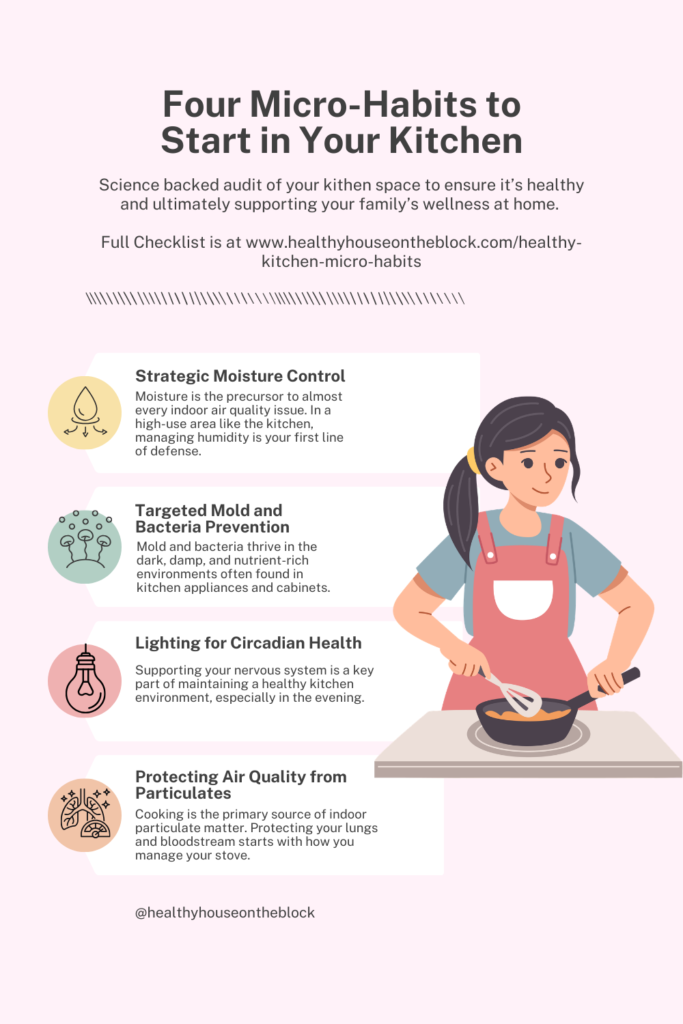
1. Strategic Moisture Control
Moisture is the precursor to almost every indoor air quality issue. In a high-use area like the kitchen, managing humidity is your first line of defense.
- The “Dry-Down” Ritual: After washing dishes, use a dry microfiber cloth to wipe the base of the faucet, the handles, and the backsplash. Standing water often seeps behind the sink or into the cabinetry below. Over time, this creates a hidden reservoir for mold.
- Mindful Mopping: When cleaning your floors, ensure your mop is damp rather than soaking wet. Excessive water on floor surfaces increases the total indoor humidity. In many homes, this extra moisture can lead to condensation in cooler corners or under cabinets, creating a perfect micro-climate for mold growth.
- Active Ventilation for Steam: Always run your vented exhaust fans when using the stove or the dishwasher. If your dishwasher does not vent outside, consider cracking a window or running a dehumidifier during the drying cycle to keep the kitchen air dry and prevent “blooming” mold on nearby surfaces.
2. Targeted Mold and Bacteria Prevention
Mold and bacteria thrive in the dark, damp, and nutrient-rich environments often found in kitchen appliances and cabinets.
- The Indoor Trash Rule: One of the most common mistakes is tossing moldy produce or bread into the trash bin located inside a kitchen cabinet. The dark, enclosed space allows mold to colonize the cabinet itself, releasing spores every time the door is opened. Take moldy items directly to the outdoor bin.
- Refrigerator Hygiene: Once a week, wipe down produce drawers and any food spills with a mixture of water and vinegar. Bacteria and certain molds can thrive even in cold temperatures (Mafe & Büsselberg, 2024). Decaying organic matter creates an “antigenic load” that circulates every time the refrigerator fan turns on.
- Deep Clean the “Hidden” Zones: Mold frequently grows in the dishwasher filter, rubber door seals, and sink drains. Once a month, remove these parts and scrub them to break up the biofilms. This prevents the “musty” smell that indicates mold spores are being distributed onto your clean dishes.

3. Lighting for Circadian Health
Supporting your nervous system is a key part of maintaining a healthy kitchen environment, especially in the evening.
- The Evening Lighting Shift: At sunset, turn off the harsh overhead LED lights. Instead, use a small counter lamp fitted with a clear incandescent bulb. Incandescent light provides a continuous, warm spectrum that does not interfere with melatonin production (Campbell et al., 2023). This simple change supports better sleep quality and helps your family wind down naturally.
4. Protecting Air Quality from Particulates
Cooking is the primary source of indoor particulate matter. Protecting your lungs and bloodstream starts with how you manage your stove.
- Proactive Cooking Ventilation: Make it a habit to turn on the range hood before you start the heat. This captures particulate matter and combustion byproducts immediately, preventing them from dispersing into the rest of your home. If you do not have a vented hood, using a high-quality HEPA air purifier in the kitchen is a vital alternative (Chin et al., 2025).
Creating a healthy kitchen is a journey of small, intentional choices. By understanding the “why” behind these habits, you are empowered to protect your family’s health from the inside out. These micro-habits may seem simple, but their cumulative effect on your immune resilience and hormonal balance is profound.

References
Amnuaylojaroen, T., & Parasin, N. (2024). Pathogenesis of PM2.5-related disorders in different age groups: Children, adults, and the elderly. Epigenomes, 8(2), 13. https://doi.org/10.3390/epigenomes8020013
Campbell, I., Sharifpour, R., & Vandewalle, G. (2023). Light as a modulator of non-image-forming brain functions—Positive and negative impacts of increasing light availability. Clocks & Sleep, 5(1), 116–140. https://doi.org/10.3390/clockssleep5010012
Chin, S., Choi, W., & Jung, S. (2025). Natural fibrous materials as eco-friendly air filters. Journal of Natural Fibers, 22. https://doi.org/10.1080/15440478.2025.2468490
Kraft, S., Buchenauer, L., & Polte, T. (2021). Mold, mycotoxins and a dysregulated immune system: A combination of concern? International Journal of Molecular Sciences, 22(22), 12269. https://doi.org/10.3390/ijms222212269
Mafe, A. N., & Büsselberg, D. (2024). Mycotoxins in food: Cancer risks and strategies for control. Foods, 13(21), 3502. https://doi.org/10.3390/foods13213502
Nemmar, A., Hoet, P. H. M., Vanquickenborne, B., Dinsdale, D., Thomeer, M., Hoylaerts, M. F., Vanbilloen, H., Mortelmans, L., & Nemery, B. (2002). Passage of inhaled particles into the blood circulation in humans. Circulation, 105(4), 411–414. https://doi.org/10.1161/hc0402.104118
Thangavel, P., Park, D., & Lee, Y.-C. (2022). Recent insights into particulate matter (PM2.5)-mediated toxicity in humans: An overview. International Journal of Environmental Research and Public Health, 19(12), 7511. https://doi.org/10.3390/ijerph19127511
Wahl, S., Engelhardt, M., Schaupp, P., Lappe, C., & Ivanov, I. V. (2019). The inner clock—Blue light sets the human rhythm. Journal of Biophotonics, 12(12). https://doi.org/10.1002/jbio.201900102
West, K. E., Jablonski, M. R., Warfield, B., Cecil, K. S., James, M., Ayers, M. A., Maida, J., Bowen, C., Sliney, D. H., Rollag, M. D., Hanifin, J. P., & Brainard, G. C. (2011). Blue light from light-emitting diodes elicits a dose-dependent suppression of melatonin in humans. Journal of Applied Physiology, 110(3), 619–626. https://doi.org/10.1152/japplphysiol.01413.2009